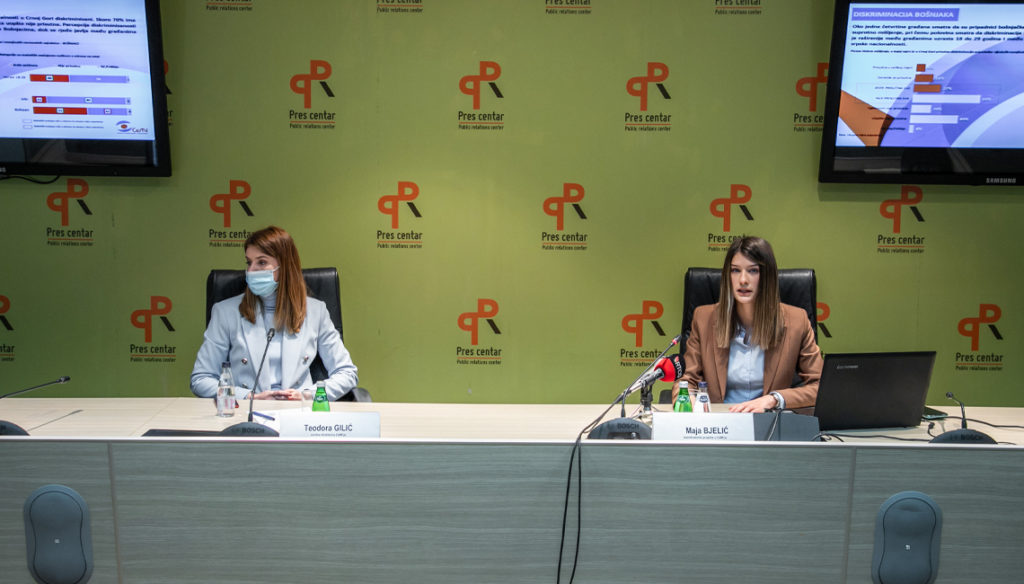
Almost half of citizens believe that there is discrimination against national minorities in Montenegro, close to two thirds of those aged 18 to 29 believe that this form of discrimination exists in society, and only one third of citizens over 60 share such an opinion.
This was shown by the research within the project "Contribution to the development and improvement of the rights of minority peoples and other minority national communities in Montenegro", which was conducted by CeMI from February 24 to 28, 2021.
The project coordinator at CeMI, Maja Bjelic, said that the research showed that the citizens of Montenegro, on average, estimate that 28% of the total population are national minorities.
"At the same time, one third of the citizens estimate the share of minorities at below 25 percent, and one quarter at 26 percent. Also, half of the citizens who recognize discrimination on a national basis know someone who has faced discrimination, "said Bjelic.
Speaking about the degree of discrimination of certain national minorities, she said that the attitude of the citizens is that members of the Roma people are most discriminated against.
"This attitude is emphasized by close to two thirds of the citizens. Here, too, we notice a significant discrepancy between the younger and older population. "More than four-fifths of citizens aged 18-29 believe that discrimination against Roma is present in Montenegro, while the same opinion is shared by less than half of citizens over the age of 60," Bjelic pointed out.
She said that in the opinion of the majority of citizens, discrimination against other minority peoples is far less present.
"One third of the respondents recognize discrimination against members of the Serbian nationality, and slightly less recognize discrimination against Albanians, Muslims and Bosnians. "When we talk about the Albanian national minority, two thirds of the citizens think that Albanians are not discriminated against, and citizens share a similar attitude when it comes to members of the Serbian nationality," said Bjelic.
According to her, similar to the issue of the Albanian national community, almost a third of citizens believe that discrimination against citizens of the Muslim national community is present in Montenegro, while two thirds of citizens disagree.
"Moreover, almost half of the citizens believe that discrimination against Muslims is not present at all. When it comes to Bosnians, a quarter of citizens believe that there is discrimination against Bosnians, while close to 70% have the opposite opinion, "said Bjelic.
The research showed that members of the Croatian national minority suffer the least discrimination.
"More precisely, about one fifth of the citizens think that Croats in Montenegro are discriminated against, while 7 out of ten citizens think the opposite," said Bjelic.
Speaking about the influence of the media on the creation of discrimination on the basis of ethnicity, 76 percent of citizens believe that the media influence the formation of attitudes towards national minorities, of which almost half believe that the influence of the media is very high.
"Although a large number of citizens express this attitude, the opinion is divided when it comes to the nature of this influence. Almost half of the citizens believe that the influence of the media on the formation of attitudes towards members of minority nations is negative. It is important to point out that citizens with a lower level of education are less likely to see the influence of the media as negative, "said Bjelic.
When it comes to employment policy in Montenegro, as she stated, slightly more than half of the citizens think that employment policies are discriminatory towards members of national minorities.
"According to the views of the citizens, the Roma suffer the greatest degree of discrimination during employment. This opinion is shared by three-fifths of citizens, "said Bjelic.
She said that the majority of Montenegrin citizens are not familiar with the affirmative actions of employing members of national minorities.
"More precisely, 7 out of 10 citizens have not heard of this type of positive discrimination. "When affirmative actions are formulated as an advantage in employment, most citizens perceive them as unfair, so only one third of citizens support such a mechanism," said Bjelic.
She pointed out that the result that almost all citizens state that they would employ a member of another nationality as employers is encouraging.
"Moreover, all socio-demographic categories of the population agree on this issue," Bjelic concluded.
CeMI Executive Director Teodora Gilic said that the research was realized within the project "Contribution to the development and improvement of the rights of minority peoples and other minority national communities in Montenegro", which was financially supported by the Ministry of Human and Minority Rights.
"The project aims to strengthen the preconditions for the common life and equality of all citizens and to promote a more active role of members of minority nations in participation in the public and private sectors. In addition, the project is aimed at strengthening the knowledge of members of minority peoples and other minority national communities about their rights and access to justice, "said Gilic.