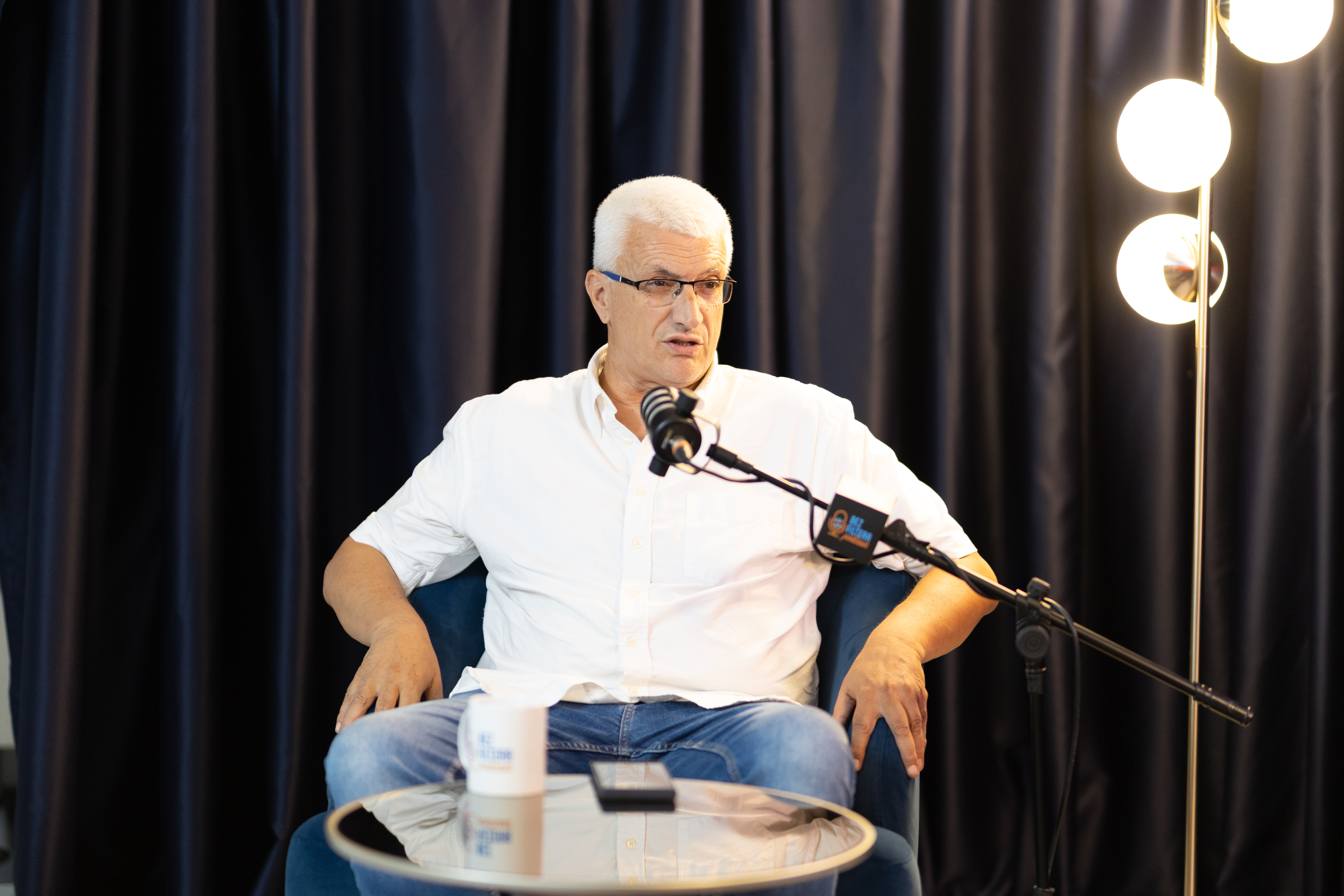
In Montenegro, ethnic Muslims are underrepresented in institutions and political life, and their numbers in population censuses are continuously declining, which is why they need an authentic political organization—the formation of which is hindered by the civic orientation of most community members, as well as the lack of an individual willing to assume its leadership.
This was assessed by Sabrija Vulić, President of the Council of the Muslim People of Montenegro, during his guest appearance on the ninth episode of our podcast "Without Filter," titled "Ethnic Muslims in Montenegro: Challenges of Political Representation."
He stated that there is deep dissatisfaction among community members regarding the results of the latest population census.
According to him, in the 1991 census, more than 14 percent of Montenegrin citizens declared themselves nationally as ethnic Muslims, whereas in the 2023 census, that figure dropped to 1.63 percent.
He noted that research conducted immediately prior to the census, according to information available to the Council, indicated that the percentage could be around four percent.
"In the end, it turned out that, under pressure and under very peculiar circumstances, that number was reduced to 1.63 percent. Because of this, we are absolutely dissatisfied," Vulić said.
He assessed that ethnic Muslims who speak the Montenegrin language and view Montenegro as their home country deserve more respect and greater representation in institutions.
Vulić believes that one of the primary reasons why the Muslim community is rarely mentioned in debates on electoral reform is the fact that it lacks adequate political representatives.
According to him, a political party that should represent the interests of ethnic Muslims exists in Montenegro, but it currently exists only formally and is not active in practice.
At this moment, there is not a single MP in the Parliament of Montenegro who declares as an ethnic Muslim. As far as I know, there isn't one in the Assembly of the Capital City either," Vulić said.
He noted that the community is predominantly civically oriented, but that such an orientation has not brought it adequate representation.
"You have around 10,000 people who subordinated their political fate to the civic concept, and in return, they get nothing," Vulić said.
He believes that civic parties often satisfy the formal representation of minorities based on candidates' names and their assumed religious affiliation, while national declaration is ignored.
Vulić claims that attempts to place representatives of ethnic Muslims on the electoral lists of civic parties faced obstacles, particularly due to assessments of how such candidacies would be received in different parts of the country.
Vulić considers that a process of assimilation and the disappearance of certain national identities is taking place in Montenegro.
He recalled that the number of citizens declaring as Muslims has dropped from census to census, noting it went from over 14 percent in 1991 down to a few percent in 2003 and 2011, and ultimately to 1.63 percent in 2023.
"Surely someone ought to ask what is happening to this ethnic community and why its numbers have been so drastically reduced," Vulić said.
He believes that neither state institutions, international partners, nor non-governmental organizations are addressing this issue sufficiently.
He called on the non-governmental sector to analyze the position and demographic decline of ethnic Muslims in Montenegro more thoroughly through research and projects.
"I have had many conversations and media appearances, but a written document that seriously addresses the issue of assimilation of ethnic Muslims is almost non-existent," he said.
Speaking on potential models of political representation, Vulić said that in an ideal civic society, national parties and national councils would be unnecessary.
However, he assessed that Montenegro has not yet reached that level of development, which is why ethnic Muslims need an authentic political organization.
According to him, the formation of an active political party is hindered precisely by the civic orientation of most community members, as well as the lack of an individual willing to assume its leadership.
He issued an open call to interested individuals to get involved in renewing the political organization of the community.
Vulić believes that the current electoral system does not allow smaller national communities a realistic chance of securing parliamentary mandates.
He explained that, due to the small size of the community, the proportion of minors, and voter turnout, an electoral list of ethnic Muslims practically cannot win a sufficient number of votes.
"To enter parliament, nearly the entire community would have to vote for a single list. That is not realistic, as people vote for various civic and other parties," Vulić said.
As a potential direction for reform, Vulić pointed to amending electoral legislation and finding a model that would enable authentic representatives of all national minorities to have a presence in parliament and full voting rights.
"It makes no sense for someone to sit in parliament without the right to vote. A solution must be found that enables real, rather than merely symbolic, representation," Vulić said.
Speaking on representation in state institutions, Vulić noted that, to his knowledge, ethnic Muslims are almost completely absent from leadership positions within the Government, ministries, and other state authorities.
He stated he was uncertain whether the Ministry of Human and Minority Rights employs a single person who declares nationally as a Muslim, while according to his information, only one member of the community is employed at the Fund for the Protection and Realization of Minority Rights.
"We have individuals with impressive degrees, master's degrees, and doctorates, yet many of them have been sidelined within their institutions and companies," Vulić said.
According to him, there have been instances where state officials, when listing minority peoples in Montenegro, omitted Muslims entirely.
"When nobody mentions you and when you are absent from institutions and the public sphere, it is only natural that assimilation takes place," Vulić said.
Vulić stated that during the 2023 census, he received calls from citizens claiming that certain enumerators told them they could not nationally declare themselves as Muslims.
He also cited examples of municipalities where, as he claims, the number of citizens declaring as Muslims was halved.
He specifically highlighted Bijelo Polje, Bar, and Podgorica, noting that a steep decline was recorded in those communities compared to the previous census.
Vulić believes that competent institutions should investigate the reasons behind such shifts, as well as establish how many members of the community are employed in state and local bodies.
Speaking about the work of the Council, Vulić noted that its activities primarily focus on publishing, cultural production, promotional events, roundtables, and panel discussions.
At the same time, he criticized the operation of the Fund for the Protection and Realization of Minority Rights, alleging that the Muslim community and its projects have been discriminated against for years.
He highlighted the composition of the commissions deciding on funding allocation as a particular issue, claiming they are dominated by representatives of a single national group.
"Out of seven commission members, six belong to the same national group. That is where the root of the problem lies," Vulić said.
He considers that a portion of the funds should be allocated directly to national councils, which would then support high-quality projects from members of their respective communities, under strict financial oversight.
He also assessed that the recommendation requiring the state to provide additional assistance to communities facing demographic decline is not being respected.
According to him, the largest communities receive the most funding, while smaller ones—including Muslims, Croats, and Roma—receive insufficient amounts.
Vulić stated that from Montenegro's accession to the European Union, he primarily expects a system in which knowledge, hard work, and experience will be valued more, and party affiliation less.
He assessed that partitocracy currently represents one of the greatest obstacles to the advancement of qualified professionals who lack political backing.
Vulić noted that during discussions with representatives of European institutions, he frequently had to explain the distinction between religious and national identity regarding Muslims with a capital "M".
"I hope that European institutions will come to understand that in Montenegro, there is a national minority called Muslims. We are even considering the possibility of changing our name, but we will see what time brings," Vulić concluded.
The podcast was produced within the framework of the project "Voice Without Barriers: Towards Greater Political Participation of Minorities," implemented by the Center for Monitoring and Research (CeMI) in partnership with the NGO Roma Youth Organization "Walk With Us – Phiren Amenca," with financial support from the Ministry of Human and Minority Rights of Montenegro.