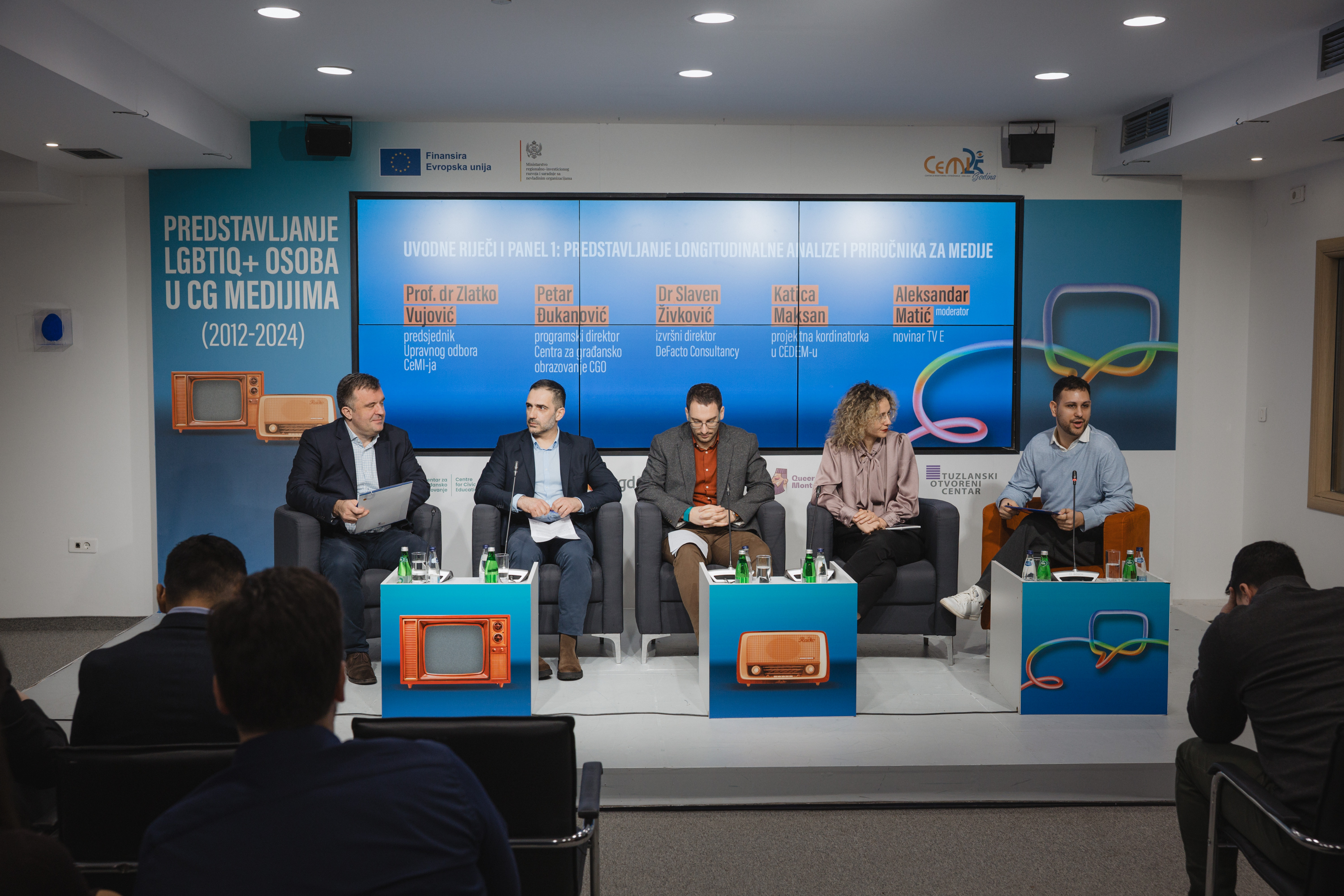
Nearly half of media articles on LGBTIQ+ topics are published in the "Politics" and "Society" sections; two-thirds of articles have at least one comment, of which about 80 percent carry a negative tone, yet a certain shift in public discourse is noticeable. This was announced at the roundtable "Representation of LGBTIQ+ Persons in Montenegrin Media," which we organized and where the "Analysis of LGBTIQ+ Community Representation in Online Media" was presented.
The President of the Governing Board of CeMI, Prof. Dr. Zlatko Vujović, emphasized that this study holds special significance for at least three reasons. "First and foremost, this is the first comprehensive longitudinal analysis of media content and online comments regarding LGBTIQ+ topics in Montenegro, covering a period of more than a decade, which is particularly significant concerning electronic media and online comments," Vujović stated. He pointed out that the research included more than 3,000 media articles and nearly 35,000 comments from three relevant Montenegrin portals.
Vujović specifically highlighted the monitoring methodology applied in the research. "The author team developed specialized software for automatic data collection from media portals, after which a combined approach was applied: manual coding by trained researchers and the use of machine learning methods—specifically, training models to classify comments by sentiment and thematic frameworks. This approach allows for the processing of a large volume of data with a high level of reliability and scientific rigor," Vujović explained. According to him, the study reflects not only on the media but on society as a whole. "The analysis shows how prejudices, fear, ideological divisions, and political instrumentalizations are mirrored in the digital space, but also that, despite the dominantly negative tone, there is a certain shift in public discourse," said Vujović.
He noted that findings indicate that comments on LGBTIQ+ topics remain predominantly negative, but their form has changed over the years, moving from overt and explicit insults
toward more subtle, politically and ideologically framed narratives. "Therefore, the analysis represents a valuable finding for the media, regulators, and organizations dealing with human rights, media literacy, and public policies," Vujović stated.
Petar Đukanović, Program Director of the Centre for Civic Education (CGO), stated that the project conducted by CeMI, which analyzes the position of LGBTIQ+ persons in the media, opens an important topic because the way these issues are represented reflects and broadens the social context. "Although the normative framework is undoubtedly better today, LGBTIQ+ persons still do not fully enjoy the rights they are entitled to. The legislative process has largely stalled, and same-sex partnerships, though they exist in the legal framework, face a lack of supporting laws and mechanisms that would allow their full application in daily life," Đukanović stated.
He specifically pointed to the position of transgender persons, emphasizing that the Law on Legal Gender Recognition based on self-determination has not been adopted for years, which, as he said, means that part of the community lacks basic legal certainty regarding their own identity. Đukanović pointed out that discrimination, hate speech, and social distance are not rare but a part of everyday life for many LGBTIQ+ persons in Montenegro.
In this context, Đukanović emphasized that the role of the media is extremely important. Media, he said, should be actors in shaping and improving the rights of LGBTIQ+ persons through their choice of topics, the language they use, the interlocutors they include, and the context they provide in their reports. "Media can contribute to the promotion and affirmation of LGBTIQ+ rights through accurate and contextualized information about laws and rights, through analytical and investigative articles explaining the broader social framework, as well as by giving space to community members to speak about their own experiences," said Đukanović.
He added that such an approach remains rare in Montenegrin media, stating that superficial and sensationalist reporting dominates, along with the unnecessary highlighting of sexual orientation or gender identity and the uncritical transmission of hate speech, further contributing to the marginalization of the community. Đukanović stressed that monitoring how LGBTIQ+ topics and persons are depicted in the media is not an attack on the media or an attempt to limit freedom of expression, but a tool for strengthening professional standards and the quality of public debate. "Such an analysis allows for the identification of patterns of stereotyping and discrimination, as well as the recognition and affirmation of examples of good practice," Đukanović concluded.
During the first panel, the Executive Director of DeFacto Consultancy, Dr. Slaven Živković, presented the results of the first longitudinal analysis of media reporting and reader comments on LGBTIQ+ topics in Montenegro, covering the period from 2012 to 2024, co-authored by Dr. Nemanja Batrićević and Dr. Marko Savić. The research analyzed 3,250 articles and nearly 35,000 comments published on the portals Vijesti, Analitika, and IN4S, with over 360,000 recorded likes and dislikes.
"The goal of the research was to identify patterns over time in the way LGBTIQ+ topics are reported and discussed, not only in media texts but also in reader comments. This analysis went a step further than previous research, as it included not only the content of the articles but also the entire discussion beneath them," Živković explained.
He stated that the researchers formed a database of articles using keywords such as LGBT, LGBTIQ+, Pride, Montenegro Pride, gay, lesbian, gender identity law based on self-determination, as well as the names of organizations like Spektra, Queer Montenegro, and LGBT Forum Progress.
"Titles, subtitles, full texts, sections, publication dates, the number of comments, and, where available, the number of views were collected. Comments were analyzed on two levels: by sentiment (positive, neutral, and negative) and by thematic categories. Part of the material was first manually coded by trained coders, after which a supervised machine learning model was developed to enable the processing of the entire corpus," Živković said.
He pointed out that, thematically, comments were initially divided into 18 categories and then consolidated into seven broader areas: human rights and discrimination; nature, biology, and "normality"; traditionalism and religion; politics, lobbying, and attention; mockery; insults and calls for violence; and general and other comments.
"More than two-thirds of the analyzed articles were published on the Vijesti portal (about 68%), 17% on Analitika, and about 15% on IN4S. Almost half of the texts were in the politics and society section, where the highest average views were also recorded – around 3,371 per article," Živković stated. He added that, on average, each text had 11 comments, and two-thirds of the articles had at least one comment, which, as he said, confirms an intense public debate.
"Three periods of increased interest were observed: 2013, during the first Pride Parade in Budva; 2018, during the debate on the Law on Life Partnership of Persons of the Same Sex; and 2021, when several cases of violence against LGBTIQ+ persons were recorded," Živković noted. He stated that the analysis shows about 80 percent of the comments had a negative tone.
"However, a negative sentiment does not necessarily mean a hostile attitude toward the LGBTIQ+ community, as part of the negative comments criticize institutions or other actors, rather than LGBTIQ+ persons themselves. The share of pro-LGBTIQ+ comments differs by portal: it is 32 percent on Analitika, 17 percent on Vijesti, while on IN4S it is only 2 percent," Živković said. He noted that nearly a fifth of the comments were classified as insults, mockery, or calls for violence, with the highest percentage on IN4S (26 percent).
He stated that although a decline in explicit insults and calls for violence has been recorded over the years—reaching its lowest level in 2024—there is a noticeable growth in comments from the categories of politics, lobbying, traditionalism, and religion. "The criticism directed at the LGBTIQ+ community has shifted over time from open attacks to narratives invoking morality, tradition, religion, ideology, and alleged media censorship," Živković added.
Based on the findings, the recommendations include a clearer definition and oversight of media responsibility in comment moderation, establishing detailed commenting rules, and organizing targeted training for journalists and media ombudsmen in recognizing manipulation and hate speech.
Presenting the "Manual for Media," project coordinator at CEDEM, Katica Maksan, stated that workshops with journalists often showed that some newsrooms lack sufficient knowledge or confidence to independently handle these topics, leading them to frequently republish content from foreign media. Maksan emphasized that the media story today does not end with the publication of a text.
"Content spreads further through social networks, where it gains new layers through comments, shares, and posts on portals of unknown origin. Comments on portals are one thing, but when a text ends up on social media, the consequences are far more serious," said Maksan, emphasizing that comments have become the central site of harm.
According to her, although the number of overt calls for violence in portal comments has decreased, such content has largely migrated to social networks, where control is more difficult and the identity of authors is often unknown.
Maksan pointed out that a specific segment of the manual is dedicated to the risks posed by Artificial Intelligence (AI). She warned that AI tools are trained on existing content and narratives and can reproduce and multiply stereotypes, prejudices, and hate speech. "AI is not something that exists independently; it is dependent on human input and control. It is possible to generate texts and images that further spread stereotypes, and the consequences of such content are borne by real people," Maksan stated.
She said that the manual is intended for journalists, editors, journalism students, civil society organizations, donors, and institutions, as well as social media management teams. "One of the important segments relates to the use of language, especially keeping in mind the specificities of the Montenegrin language and the limited possibilities for gender-neutral expression. The manual provides guidelines on how to report respectfully on persons of different gender identities, including those for whom established terms do not exist in the language," said Maksan.
Special attention, she added, was paid to headlines and "framing," as they directly influence the tone and content of comments. Maksan pointed out that a sensationalist approach, as well as the use of generic or stereotypical photographs—particularly regarding topics concerning trans persons or the drag community—can further reinforce negative public attitudes.
"The manual also contains a comment moderation model, created in conversation with people who manage social networks and portal comments. It also addresses the issue of where negative content can be reported and how to act in crisis situations, including cases where problematic texts are published," Maksan noted.
She indicated that the structure of the document covers the media narrative and its impact, terminology, ethical reporting, online comments and hate speech, as well as practical tools, including a checklist that journalists and editors can use before publishing a text. Maksan emphasized that the goal of the manual is to reduce harm in public discourse, strengthen professional standards, and support an inclusive society. She stressed that the document does not represent a final solution, but rather a basis for further discussion and cooperation between the media and the civil sector.
The roundtable is organized within the project "From Silence to Narrative: Representation of the LGBTIQ+ Community in Montenegrin Media (2011–2024)," which we are implementing with the support of the broader program "Together for LGBTIQ+ Equality," led by the Centre for Civic Education (CGO) in partnership with ERA – LGBTI Equal Rights Association for the Western Balkans and Turkey, Queer Montenegro, Queer Center Skopje, Tuzla Open Center, Open Mind Spectrum Albania, and the Center for Social Group Development from Kosovo (CSGD). The project is funded by the European Union and co-funded by the Ministry of Regional-Investment Development and Cooperation with Non-Governmental Organizations.