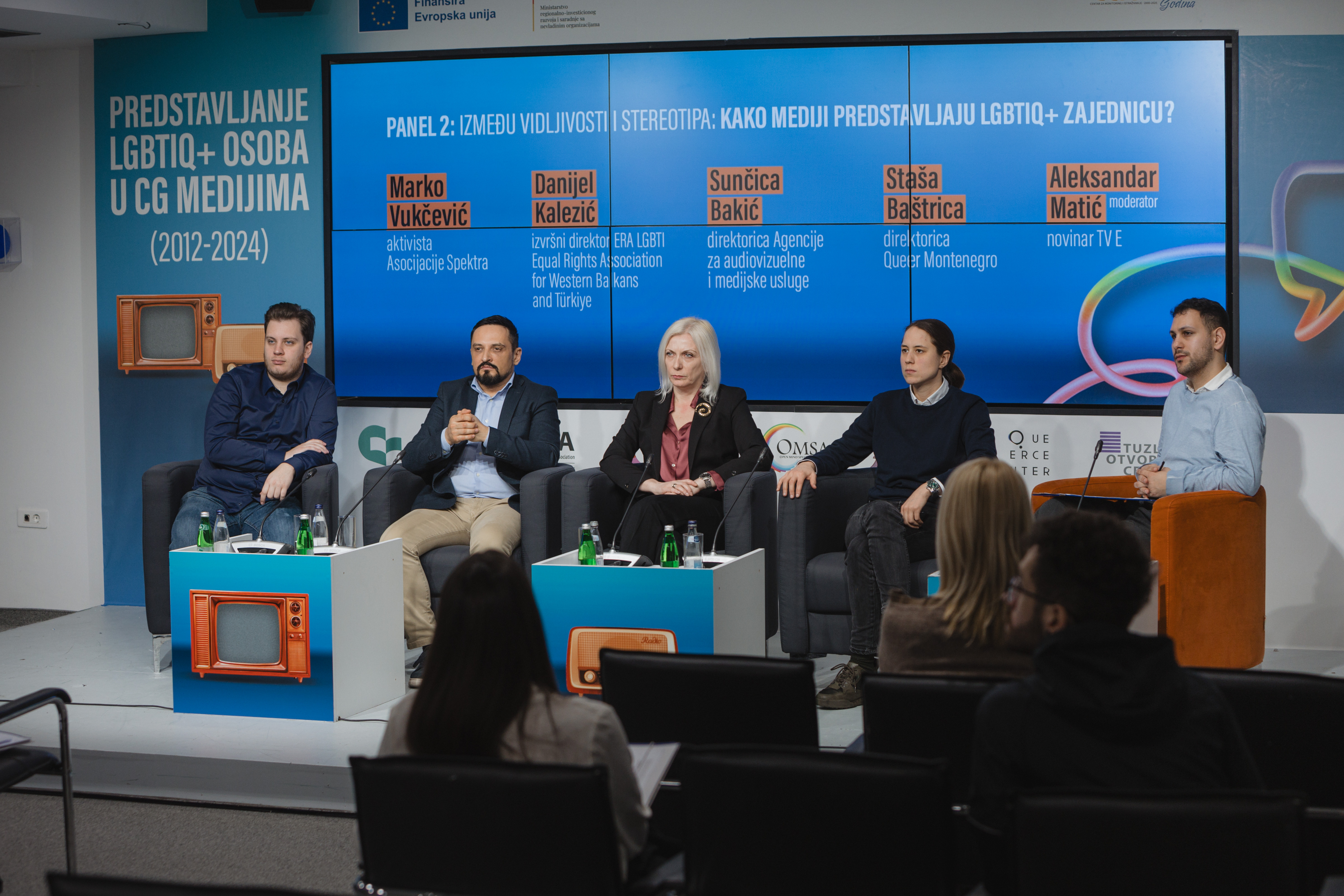
Strategic legislative reform and responsible media reporting are crucial for the protection of the LGBTIQ+ community, as the lack of investigative coverage of these topics in the media perpetuates prejudices and stereotypes, further marginalizing community members and placing them outside the framework of basic civil rights.
This was assessed during the second panel, "Between Visibility and Stereotypes: How Media Represent the LGBTIQ+ Community?" held as part of the roundtable "Representation of LGBTIQ+ Persons in Montenegrin Media," which we organized today.
Marko Vukčević, an activist from the Association Spektra, pointed out that LGBTIQ+ persons encounter negative comments daily, both in the media and on social networks. "Donors often ask if we report the comments we receive, but it simply isn't possible in every case. The volume of negative comments is so high that constantly reporting them would require an immense amount of time, unless they involve serious threats," Vukčević explained.
He emphasized that the media play a key role in creating a safer public space. "It is important for the media to more seriously monitor problematic comments and assess whether the situation is
improving. Currently, the removal of offensive content is insufficiently systematic and is not at a high level," Vukčević assessed. He also noted a decline in media reporting on the community, especially during periods of important political campaigns, such as the campaign for the Law on Legal Gender Recognition based on self-determination.
"In the 2022–2024 period, when two Prides were held and the community's political demands were clear, media reporting on the needs of the queer community significantly decreased. At the same time, cultural events organized by the community, such as film and book promotions, are almost never mentioned in the media," Vukčević said. He concluded that the situation is concerning, stating that the public scene remains insufficiently inclusive, which shows the need for continuous work and greater media support.
Danijel Kalezić, Executive Director of the ERA LGBTI Association, emphasized that negative comments and hate speech against LGBT persons are just one small "puzzle piece in a larger problem." "This does not exclusively concern LGBT persons; it shows the flaws of the entire legal framework that does not enable an effective resolution of these phenomena," Kalezić said.
He pointed out that while portals moderate comments, users on social networks can freely spread offensive content. Kalezić noted that institutions still do not take responsibility for solving the problem; instead, it falls to non-governmental organizations and activists to collect and report such content.
He also highlighted deficiencies in the new police application for reporting violations. "Although the application allows for submitting reports with photos and videos, practice shows that after ten days, the police require everything to be repeated in person, making the process long and inefficient," Kalezić explained. According to him, the solution lies in the strategic regulation of policy and law, so that no one feels free to spread hatred toward anyone.
"The state must provide the conditions to solve the problem properly. The civil sector does not have the resources to continuously report all comments, and the media often exploit LGBT topics to increase public attention," Kalezić concluded.
The Director of the Agency for Audio-Visual Media Services, Sunčica Bakić, clarified that the Agency monitors the work of radio and television programs, while portals are tracked only in cases where they have separate video sections. “Unfortunately, the online media system in Montenegro is not yet legally harmonized, which makes the oversight and regulation of comments difficult,” Bakić pointed out.
According to her, comments on portals and social networks often reflect narratives created by traditional media. “Social networks primarily serve to distribute already formed narratives. Traditional media still create key stories and influence public discourse,” Bakić stated. She noted that cases of violating the rights of LGBT persons in the media are rare but serious, noting that the Agency recently handled two cases involving national broadcasters.
She warned of the danger of the “normalization” of hate speech through mild or subtle comments. “Even if explicit hate speech is no longer used, this style of commenting can pass under the radar and leads to the normalization of harmful narratives in society,” Bakić emphasized. She concluded that media coverage of the queer community is mostly treated within a political context, while cultural and social aspects remain marginalized.
The Director of Queer Montenegro, Staša Baštrica, explained that the data showing 80 percent of comments in media articles are negative does not necessarily mean that 80 percent of citizens hold negative views. “It is important to understand that many of these comments contain elements of hate speech and that moderation is key so that such content does not spread on social networks,” Baštrica emphasized.
She pointed out the harmful impact of negative comments on the mental health of LGBT persons. “From personal experience, during my public work as a lesbian and activist, I have faced insults and threats on social media. Such comments can seriously affect the sense of personal safety,” she said. Baštrica also commented on how the media report on the community, noting that they often focus on sensationalist headlines, such as ‘the first lesbian in Parliament,’ instead of addressing the actual lives and rights of LGBT persons.
“Journalists often avoid detailed reporting on LGBT topics, despite evidence from the field showing constant oppression and challenges faced by the community. Such reporting further marginalizes LGBT persons and places them outside the framework of civil rights,” Baštrica concluded.
The roundtable was organized within the project “From Silence to Narrative: Representation of the LGBTIQ+ Community in Montenegrin Media (2011–2024),” implemented by CeMI and supported through the broader program “Together for LGBTIQ+ Equality,” led by the Centre for Civic Education (CGO) in partnership with ERA – LGBTI Equal Rights Association for the Western Balkans and Turkey, Queer Montenegro, Queer Center Skopje, Tuzla Open Center, Open Mind Spectrum Albania, and the Center for Social Group Development from Kosovo (CSGD). The project is funded by the European Union and co-funded by the Ministry of Regional-Investment Development and Cooperation with Non-Governmental Organizations.