Artificial intelligence can contribute to digital sovereignty, a more efficient public administration, and democratic resilience only if introduced in a planned manner, alongside a secure and interoperable data infrastructure, a developed digital identity, expert capacities, transparency, and clear institutional accountability; otherwise, its ad hoc application may produce more risks than benefits.
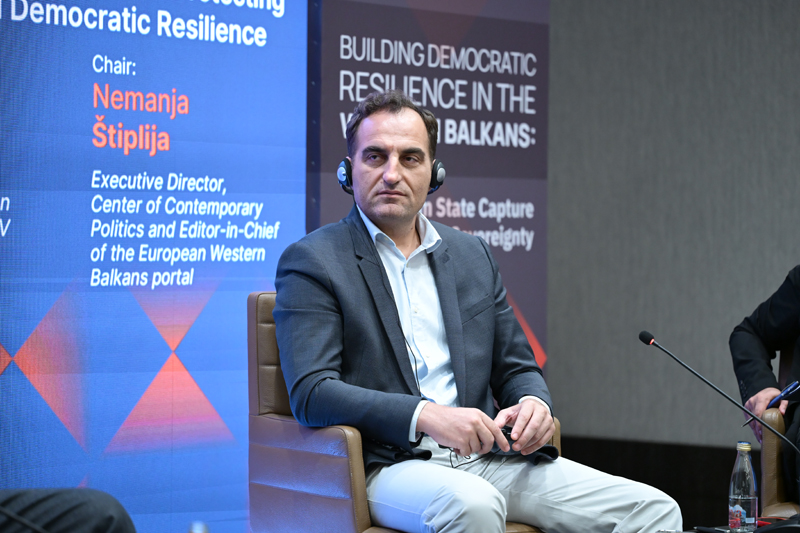
This was stated during the third panel, titled "Digital Sovereignty and Governance: Artificial Intelligence as a Tool for Protecting the EU Information Space, Economic Security, and Democratic Resilience," held within the Regional Anti-Corruption Policy Forum "Building Democratic Resilience in the Western Balkans: From State Capture to Digital Sovereignty," organized by the Centre for Monitoring and Research (CeMI).
State Secretary at the Ministry of Public Administration, Naim Gjokaj, emphasized that Montenegro is working on its first Artificial Intelligence Strategy, stating that inter-ministerial consultations have been completed and that public consultations involving the academic community, the business sector, and domain experts will follow in the upcoming period.
As he stated, the objective is for the strategy to serve as the foundation for developing legal and other mechanisms for AI development in Montenegro.
Gjokaj stressed that digitalization cannot be separated from security issues.
"We cannot engage in any form of digitalization without strong security," Gjokaj said, recalling the cyberattacks on the state administration in 2022.
As he noted, in addition to the national CIRT within the Ministry, which monitors the security of the state network, a national Cyber Security Agency has also been established to monitor critical infrastructure.
"We can never say that we are 100 percent secure. No system, no state, and no private sector can say they are 100 percent secure," Gjokaj said.
Speaking about building expert capacities, Gjokaj assessed that Podgorica is becoming a regional hub for cybersecurity. He recalled that Montenegro, France, and Slovenia established the Regional Capacity Building Center in Podgorica, aimed at strengthening human resources not only in Montenegro but across the region.
Regarding artificial intelligence, Gjokaj emphasized that data forms the foundation of its development and that AI should not replace humans in decision-making.
"In many sectors of public administration, artificial intelligence cannot replace human judgment. Its role should primarily be to assist civil servants, especially in analyzing large volumes of data and documents. What matters is not how fast that AI mechanism is, but how much it reduces and shortens processing time for the citizen," Gjokaj said.
He stressed that when digitalizing services, careful consideration must be given to what citizens actually need.
Gjokaj noted that certain ministries are already utilizing specific AI tools and that initial mechanisms exist on official government and ministry websites through systems that enable citizens to obtain necessary information.
The future strategy, as he said, should analyze which AI tools are already in use within public administration, as well as what could be utilized in the future.
"One of the key prerequisites for the further development of digitalization and artificial intelligence is data interoperability. Data must be interoperable. That is paramount. It is the key to any potential digitalization and AI development," Gjokaj said.
He stated that citizens in Montenegro can currently submit administrative requests electronically for numerous procedures, but in certain cases, they cannot receive final decisions or documents from public administration electronically.
He cited an insufficiently developed digital identity as one of the reasons, along with the need to develop a digital citizen mailbox.
According to him, unified data registries namely, connecting databases across different institutions will also represent an important foundation for AI development.
Gjokaj also pointed out disparities in the level of digital development among local self-governments.
"The Capital City of Podgorica possesses the financial, human, and technological capacities for digital transformation, whereas certain less-developed municipalities, particularly in the north, lack even the basic technological conditions for such a process," Gjokaj noted.
For this reason, as he explained, the development of digital services and future AI mechanisms must be grounded in data interoperability.
"Interoperability will also be essential for the development of a digital wallet and for connecting the countries of the region so that citizens can enjoy the benefits of digital services," Gjokaj concluded.
The Director of the Agency for Identification Documents, Registers and Data Exchange, Dr. Almir Badnjević, speaking on the application of AI in public administration, emphasized that before using such systems, it must be clear where they will be used, why, and based on what data.
"If we do not know this and if we lack methods for how to do it, we will not reap the benefits of artificial intelligence," Badnjević said.
He particularly pointed to processes of great importance to citizens, stating that in such cases, everything comes back down to core infrastructure and accurate data.
"Such processes require critical infrastructure, digital identity, and control over data. Only when we have that, when we control it, and when we possess a form of digital sovereignty can we discuss applying artificial intelligence to that data and those processes," Badnjević noted.
He also warned of the distinction between commercial AI tools and systems used by the state.
While citizens can use commercial tools at their own risk, according to him, the situation is different when the state deploys an AI-based system.
"If the state launches something based on AI, it can no longer be at one's own risk, because the state stands behind it," Badnjević said.
Badnjević explained that the Agency has resolved two crucial steps in communication between citizens and public administration: digital identification and qualified electronic signatures.
"Citizens using these services no longer need to physically visit a service counter to identify themselves with an ID document; they can do so digitally. Furthermore, they can sign documents using a qualified electronic signature, and both services are free of charge," Badnjević said.
He emphasized that digital transformation brings greater oversight of processes, as electronic audit trails remain showing when a request was submitted, who worked on the file, and what actions were taken.
Digital transformation expert at SCiDEV, Dr. Erjon Curraj, assessed that it is difficult to expect concentrated and well-planned national AI initiatives if states lack appropriate strategies and clearly defined priorities.
He also recalled the importance of regional initiatives, such as the Cybersecurity Center and the Western Balkans Cyber Capacity Center, stating that such mechanisms can play a vital role in capacity building.
According to him, problems arise when artificial intelligence is introduced without sufficient prior planning and assessment of technical, legal, and social conditions.
"If you lack a strategy, you end up with what we are already witnessing ad hoc implementations," Curraj said.
As he explained, countries in the region possess data, but the key question is not merely whether data exists, but how prepared it is for AI systems to actually utilize it.
"All economies have data. But how ready that data is to be used by artificial intelligence that is a completely different story," Curraj said.
According to him, beyond appropriate data and infrastructure, successful AI deployment requires people equipped with the necessary knowledge and skills.
Curraj warned of a gap between political messaging regarding the capabilities of artificial intelligence and the actual readiness of institutions to implement it.
He described this phenomenon as a form of "AI inflation" a situation in which government officials promise that AI can solve a vast number of social and economic problems, while the technical, legal, and institutional prerequisites for such projects remain insufficiently developed.
He paid special attention to claims that AI can be used to combat corruption.
According to him, it is not enough to announce that AI will be used, for example, in public procurement to reduce corruption. It is also necessary to analyze how those AI solutions themselves are procured, who develops them, and how transparent the entire process is.
"You may be trying to combat petty corruption while grand corruption takes place behind the scenes," Curraj warned.
For this reason, he believes citizens should not simply accept promises that AI will bring massive improvements; they must have the ability to see how these systems are developed and brought into operation.
One of the key problems, according to Curraj, is an insufficient level of knowledge regarding artificial intelligence.
While a solid understanding of the field already exists among certain institutional representatives, he noted that this is not the case across all levels of government.
However, he particularly pointed out the lack of AI literacy within civil society, stating that civil society should serve as a counterweight to authorities and be able to expertly assess what institutions are doing with new technologies.
Therefore, knowledge- and skill-building programs are needed to enable better oversight, greater transparency, and higher-quality implementation of AI initiatives.
Such an approach, Curraj believes, can contribute not only to technological development but also to safeguarding democracy, media freedom, and freedom of expression.
Speaking about innovation, Curraj assessed that countries in the region have the opportunity to leapfrog certain development stages through new technologies, but only if their approach is well-conceived.
"We have the opportunity to make a developmental leap. But if we continue operating as we currently do, we will not move forward we will move backward," Curraj said.
He believes it is necessary to clearly define priorities.
"Instead of launching a vast number of projects simultaneously just because a certain technology is currently popular or used by politicians in other countries, authorities should identify areas where AI can deliver the greatest benefit. This could be digital identity, e-government services, or other sectors, but it must be done step by step," Curraj said.
Curraj noted that assessing the success of AI policies should not begin only after a system has been implemented.
"Accountability must exist from the very moment the state decides where to invest money, time, and expert capacity. Questions must be answered as to why a specific AI application was chosen over another solution, and whether it will genuinely contribute to the goals set by the government," Curraj stated.
The event was organized with the financial support of the European Union and the Central European Initiative, with contributions from the Ministry of Foreign Affairs and International Cooperation of the Republic of Italy.