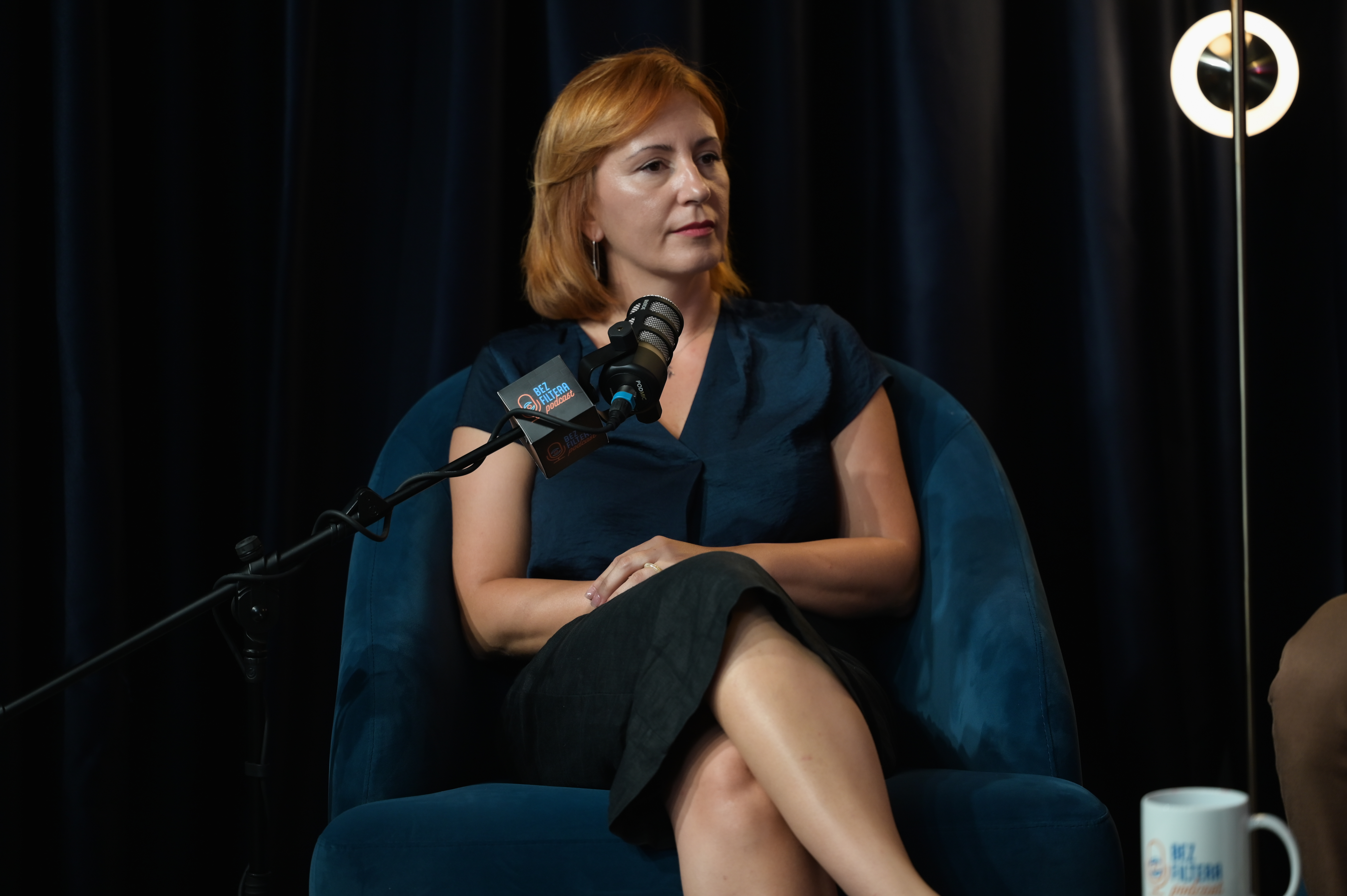
The influence of large capital, pressure on officials, and a shortage of inspectors make it difficult to prove environmental crime, which is why Montenegro must strengthen its institutions, strategically plan development, and reject projects that jeopardize national interests and natural resources.
This was evaluated in the eleventh episode of the podcast "Without Filter," produced by the Center for Monitoring and Research (CeMI).
Azra Vuković, Executive Director of the non-governmental organization (NGO) Green Home, stated that it is difficult to draw a clear line between the lack of administrative capacity, institutional irresponsibility, and corruption.
She noted that one can talk about potential corrupt interests when the same problems recur for years, despite warnings from citizens, activists, civil society organizations, and the expert public.
As examples, she cited the illegal extraction of gravel and sand from the Morača River, as well as the continuous discharge of pollutants into the Zeta River.
"When responsibility is shifted from one inspection authority to another and there is no coordination, it indicates a lack of will to solve the problem," Vuković said.
According to her, the legal framework for environmental protection often changes slowly, while certain provisions are delayed because they do not suit commercial entities that pollute or exploit natural resources.
Vuković assessed that problems remain even after laws are passed, because their implementation on the ground is inadequate.
"In this way, certain businesses continue to profit from natural resources that belong to everyone, not just to those who exploit them," Vuković said.
Vanja Cicmil, Executive Director of the NGO Zero Waste Montenegro, stated that the situation in the waste management sector has remained the same for years or is further deteriorating.
She noted that accountability is key to distinguishing systemic sluggishness from corruption, because when a certain system is not established for years, the question justifiedly arises as to who benefits from such a state of affairs.
Cicmil recalled that Extended Producer Responsibility was introduced in 2018, but that the necessary bylaws to regulate obligations for different types of waste in greater detail were never adopted.
Because of this, as she explained, manufacturers and importers do not bear financial responsibility for products and packaging at the end of their lifecycle; instead, the burden of waste management falls on the state and its citizens.
She believes that pressure from the European Union (EU) is mostly focused on adopting and harmonizing legislation, while progress in its implementation remains severely limited.
"Citizens should ask whether the European integration process brings changes that are actually reflected in their quality of life, the state of rivers, coasts, and the overall environment," Cicmil said.
Environmental activist Vuk Vujisić assessed that corruption and a lack of capacity are intertwined, noting that the influence of big capital, pressure on officials, and an insufficient number of inspectors pose serious obstacles in the fight against environmental crime.
He said that information about problems on the ground often comes first from citizens and the civil sector, who then inform domestic institutions, the EU Delegation, and the international community.
Vujisić stated that the illegal extraction of gravel persists despite police actions and legislative amendments, estimating that around 30 million euros—which remain without proper control—circulate in this sector annually.
According to him, certain progress has been achieved through the formation of environmental crime units within the police and prosecution services, intended to foster cooperation among representatives of multiple institutions.
However, he warned that it takes only a single link in the chain of accountability to fail or challenge the established findings for proving environmental crime to become significantly more difficult.
"There are not enough inspectors, police officers, or equipment. Some inspectors go into the field in their own vehicles, while on the other side, there are often companies and individuals with substantial financial and political influence," Vujisić said.
He believes that honorable officials within institutions must be protected, while those who obstruct proceedings should be prosecuted.
Speaking about the state's relationship with private investors, Vuković said that Montenegro must strengthen its institutions so they are capable of rejecting projects that align neither with the interests of the state nor with the protection of natural resources.
According to her, the state should strategically plan its development and offer investors projects that it actually needs, rather than adapting planning documents and strategies to investor demands.
"We do not plan our space and future as imagined by the people who live here; instead, we allow ideas to come from the outside and plans to be altered based on investor interest," Vuković said.
She noted that a strong Ministry of Ecology, the Environmental Protection Agency, and institutions responsible for spatial planning must be capable of declaring that a given project is unacceptable for a protected or ecologically valuable area.
Vuković pointed out that the Natura 2000 habitat mapping process shows that more than half of Montenegro's territory should be protected, which, in her view, speaks to the exceptional value of the country's natural resources.
Cicmil stated that the issue in waste management is not a lack of awareness-raising campaigns, but the fact that citizens often lack the practical means to separate waste.
She assessed that the system and infrastructure must be established before asking citizens to change their habits.
"Citizens are the last link in the chain. Without a functional system, campaigns will yield very limited results," Cicmil said.
Speaking on waste management investments, Cicmil warned against starting with large infrastructure projects, emphasizing instead local solutions, separate waste collection, recycling yards, and building the capacity of local self-governments.
Cicmil highlighted as problematic the announcement of talks with an investor regarding the construction of a waste-to-energy plant in Podgorica prior to the completion of a feasibility study, public consultations, and discussions with experts and the civil sector.
"It begs the question of whether the decision on technology has already been made before completing all necessary analyses," Cicmil said.
Vujisić recalled that civic activists partially succeeded in stopping illegal gravel extraction along the banks of the Morača River, which was followed by police actions and legislative amendments that now allow for easier seizure of trucks and excavators caught in illegal operations.
He warned that quarries also pose a major problem, noting that Montenegro has only one mining inspector responsible for controlling both legal and illegal quarries and mines.
Vujisić also pointed to cases of illegal logging, pollution of the Zeta River, interventions in Baošići and other parts of the Bay of Kotor, as well as illegal dumpsites.
According to him, Montenegro has only two sanitary landfills—in Podgorica and Bar—while numerous other disposal sites function as temporary and illegal solutions.
He noted that the Environmental Protection Agency launched a platform allowing citizens to anonymously report environmental crime and violations, but that some inspectorates still show resistance to going out into the field and conducting supervision.
Speaking on priority reforms, Vuković said she would focus on increasing transparency, so that citizens and the civil sector receive timely information and can react before work begins on the ground.
Cicmil highlighted the collection of reliable data on waste quantities and composition at the local level as her priority, stating that without this, it is impossible to draft quality plans and strategies.
Vujisić said reforms of the inspection services, police, and judiciary are needed so there are enough officers, equipment, and final convictions for environmental crime.
He added that education reform is also essential, so that every citizen understands sustainable development, the meaning of an ecological state, and their own rights and obligations upon completing their schooling.
The speakers assessed that there is a possibility Chapter 27 could be provisionally closed by the end of the year, but warned that formal closure does not mean the problems have been resolved.
Vuković stated that numerous long-awaited laws, acts, and strategies were adopted in the preceding period, but their implementation is lagging.
Cicmil assessed that the focus should not merely be on the chapter's closing date, but on when the reforms will actually be implemented and when citizens will feel their results.
Vujisić believes that closing Chapter 27 would primarily be a political decision.
"It is positive for Montenegro to complete the European integration process, but when it comes to enforcing regulations, we are still far from where we need to be," Vujisić concluded.