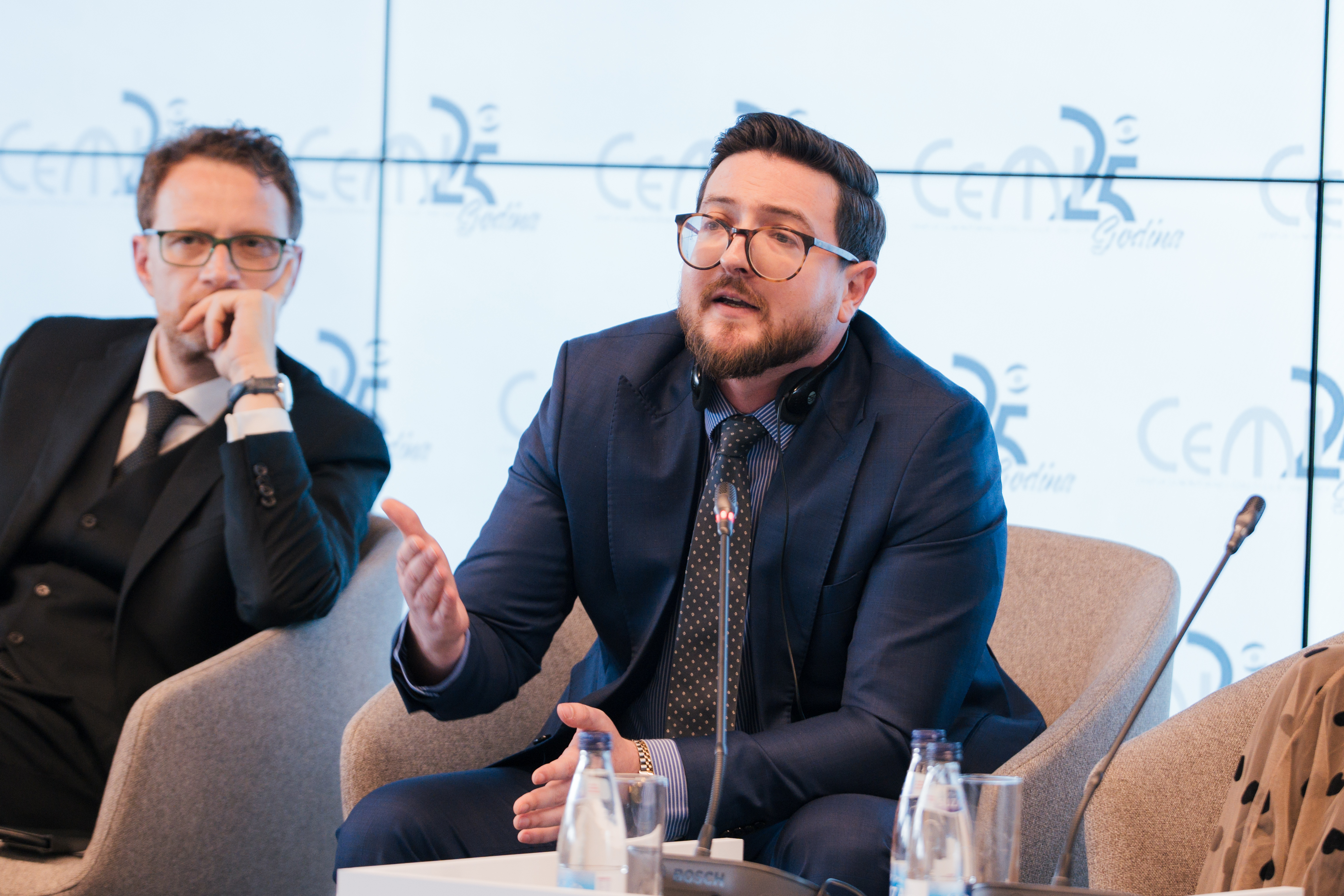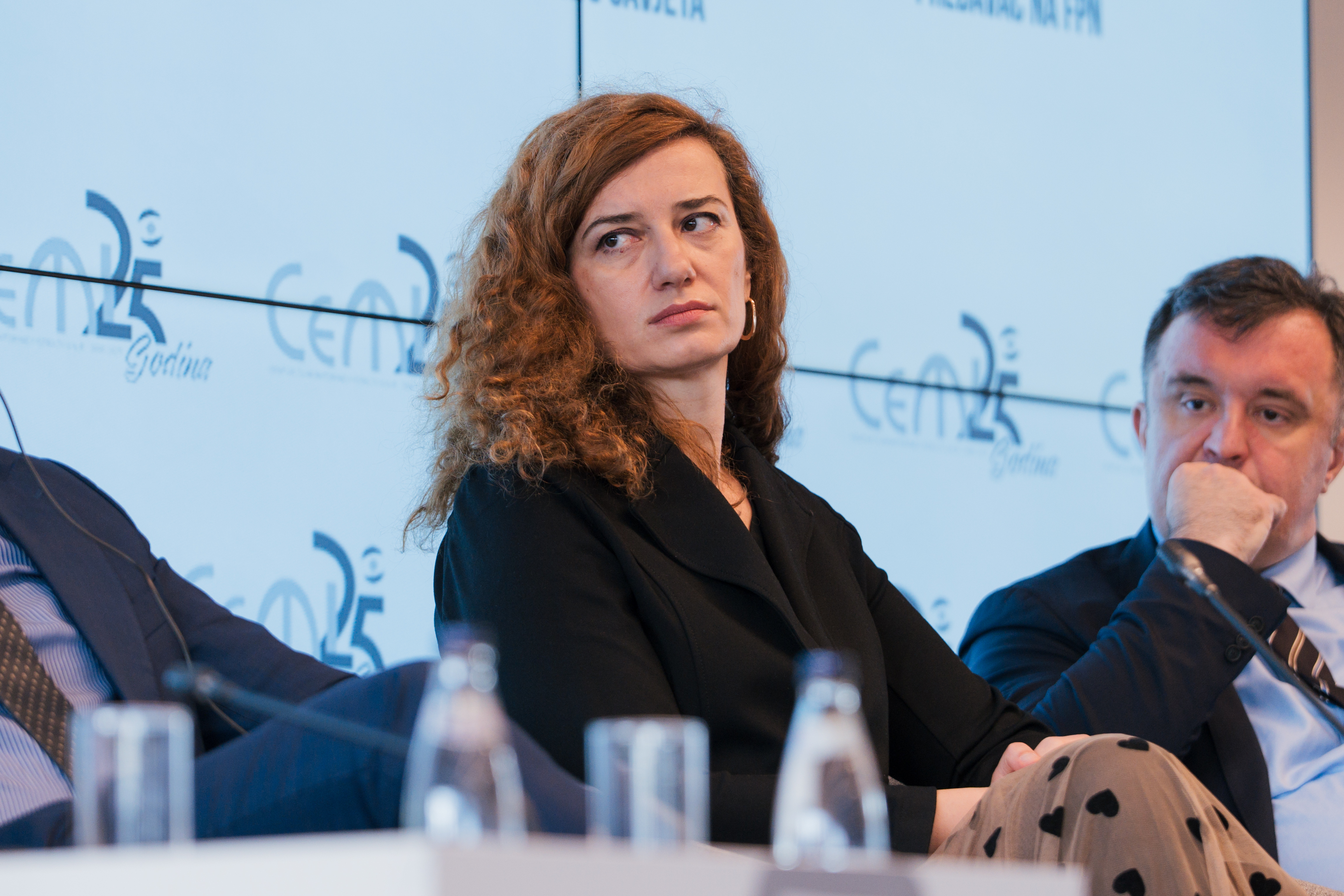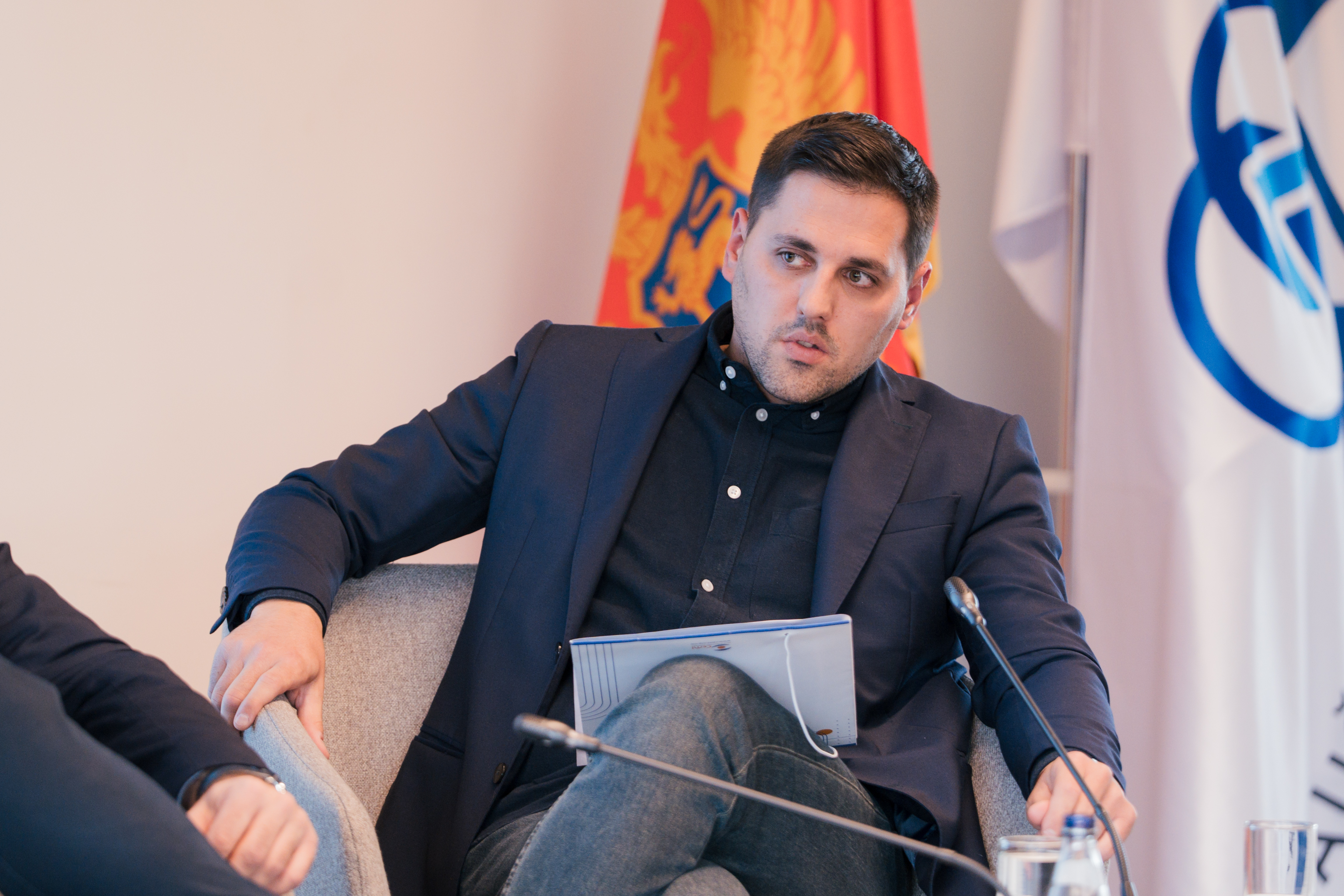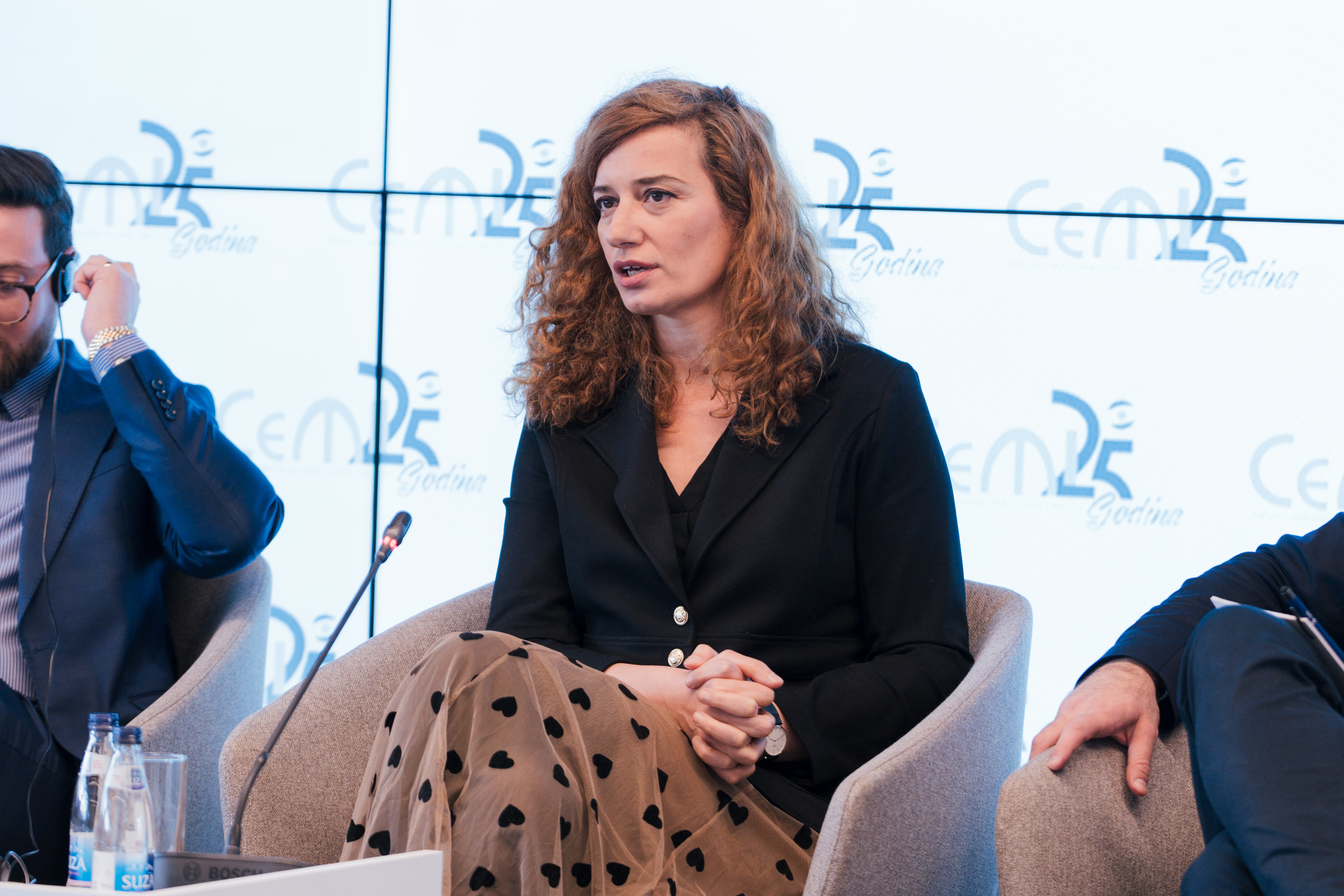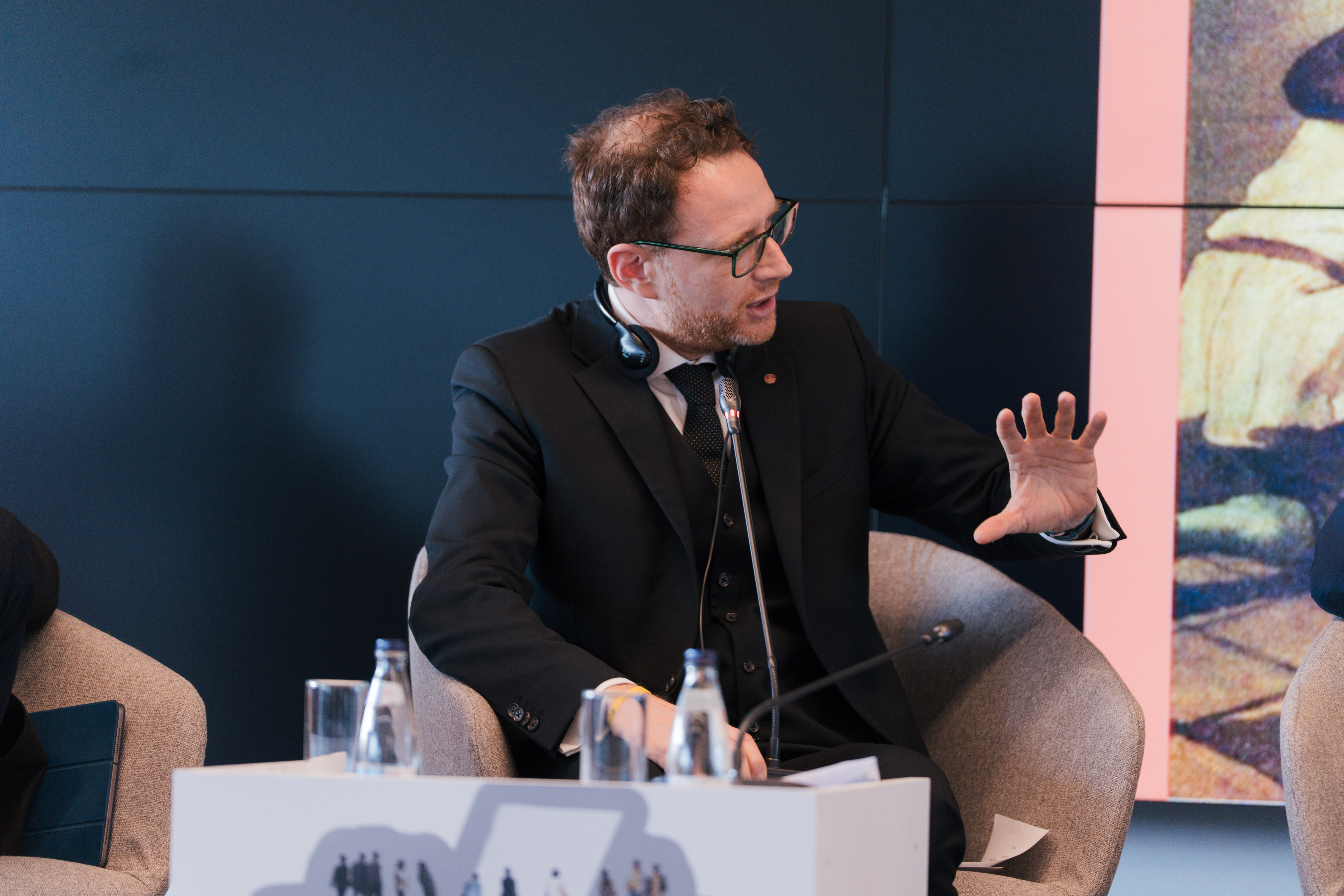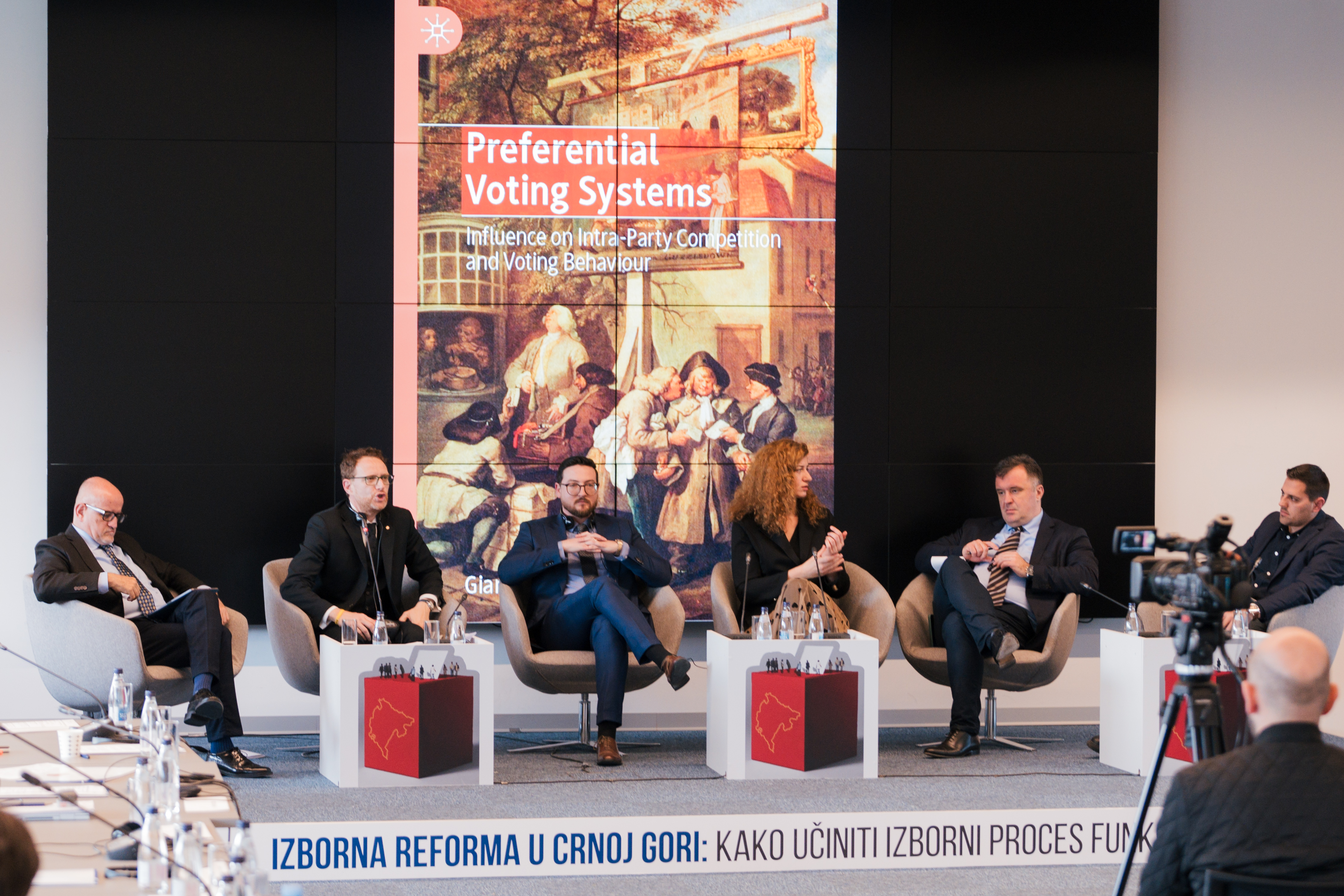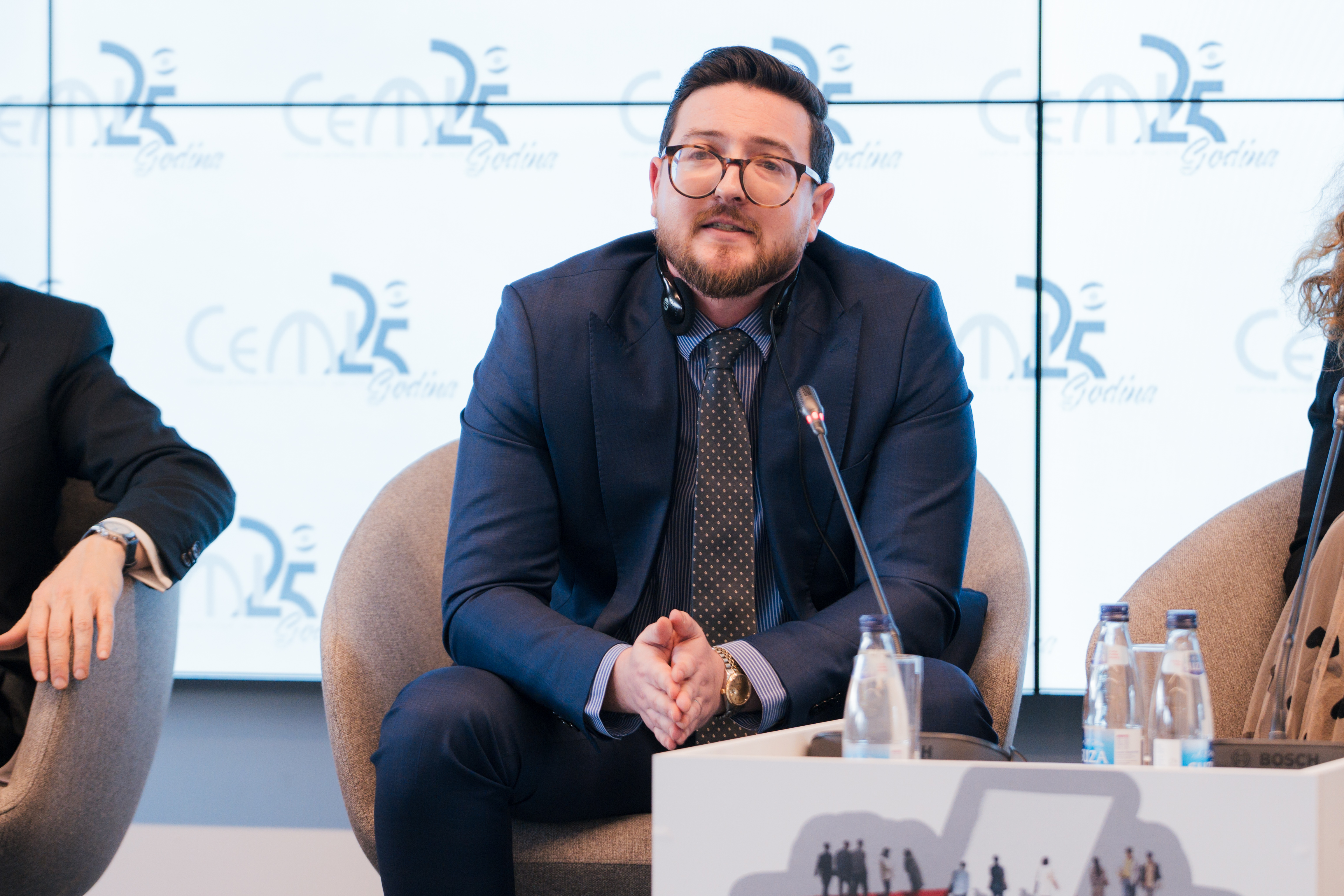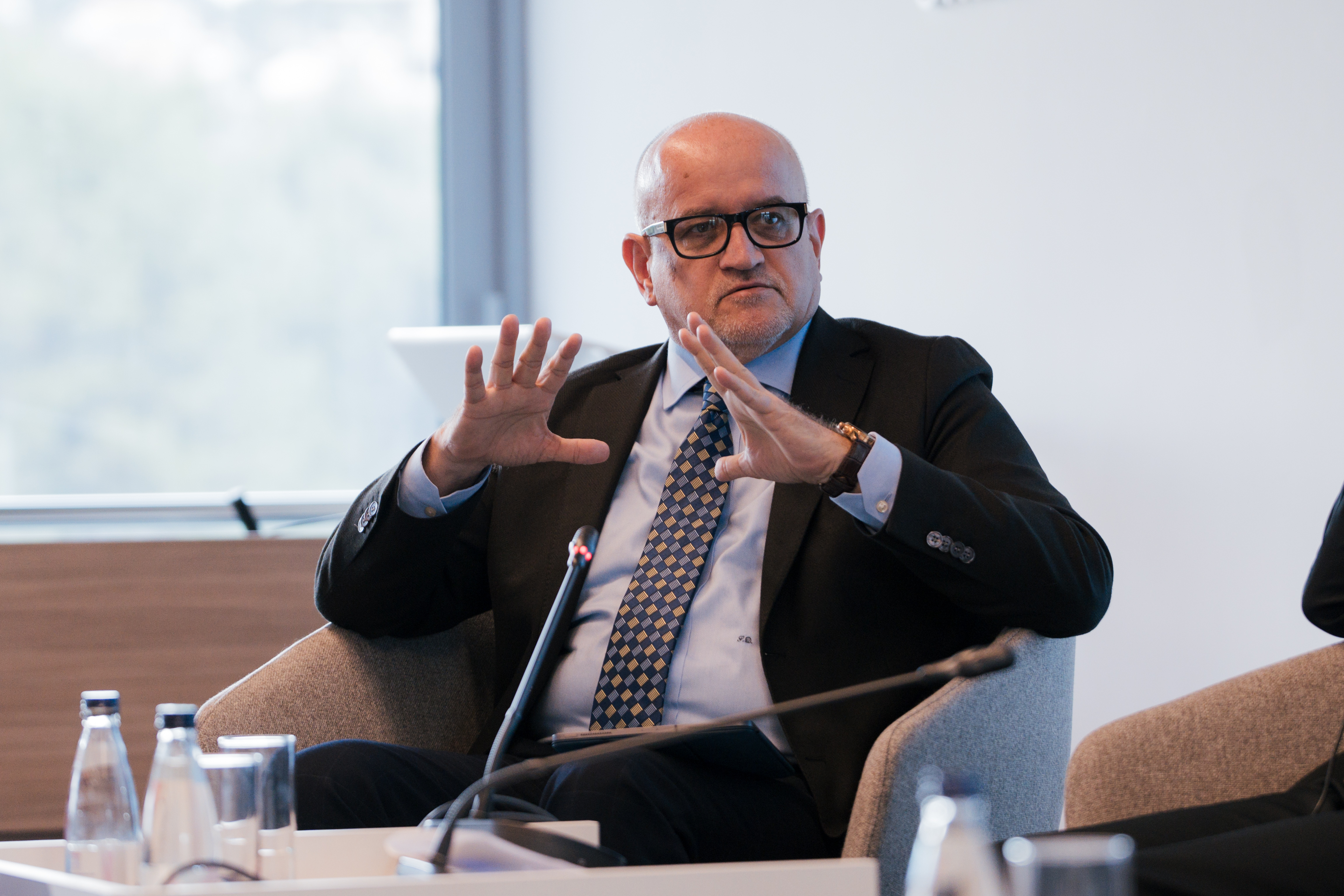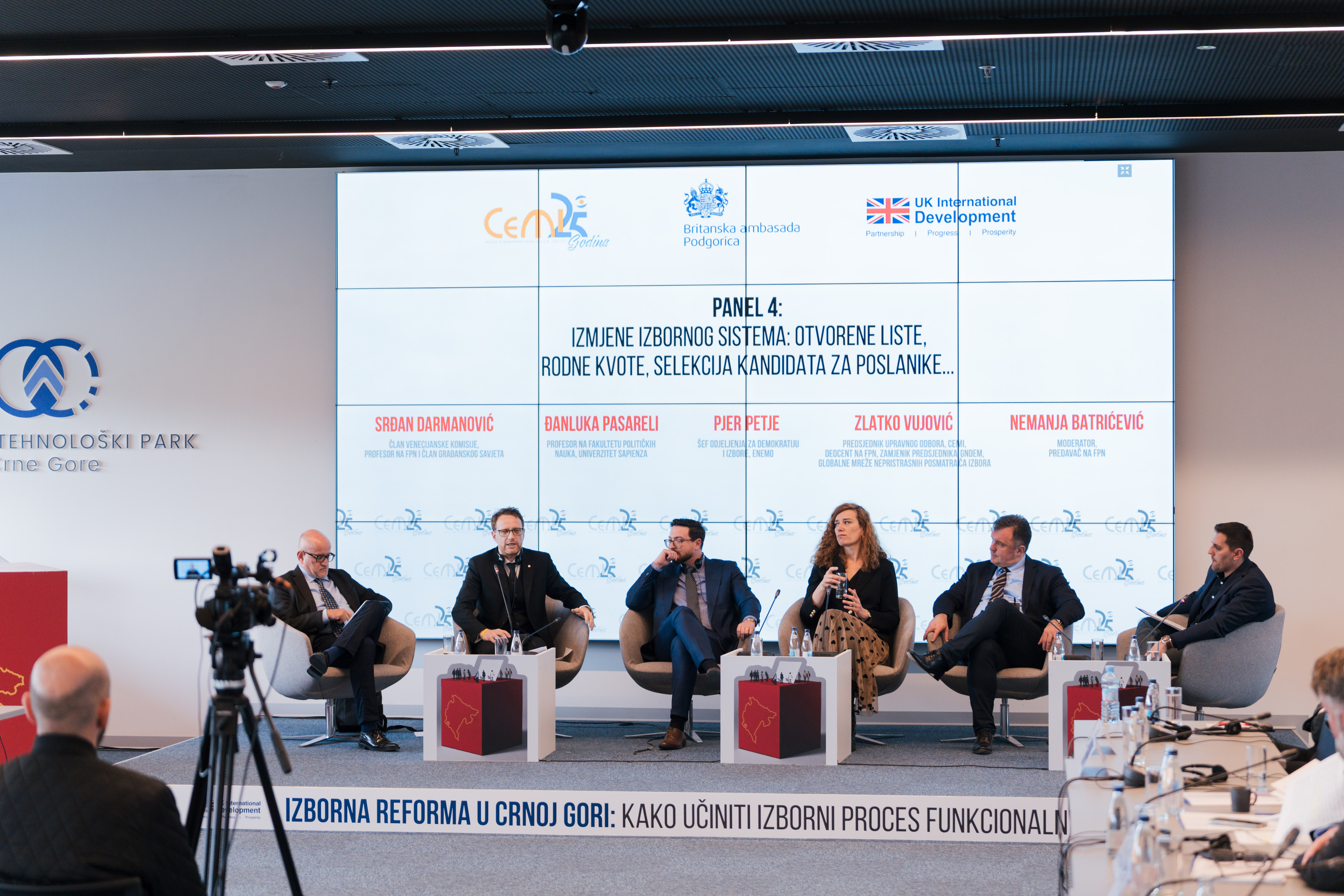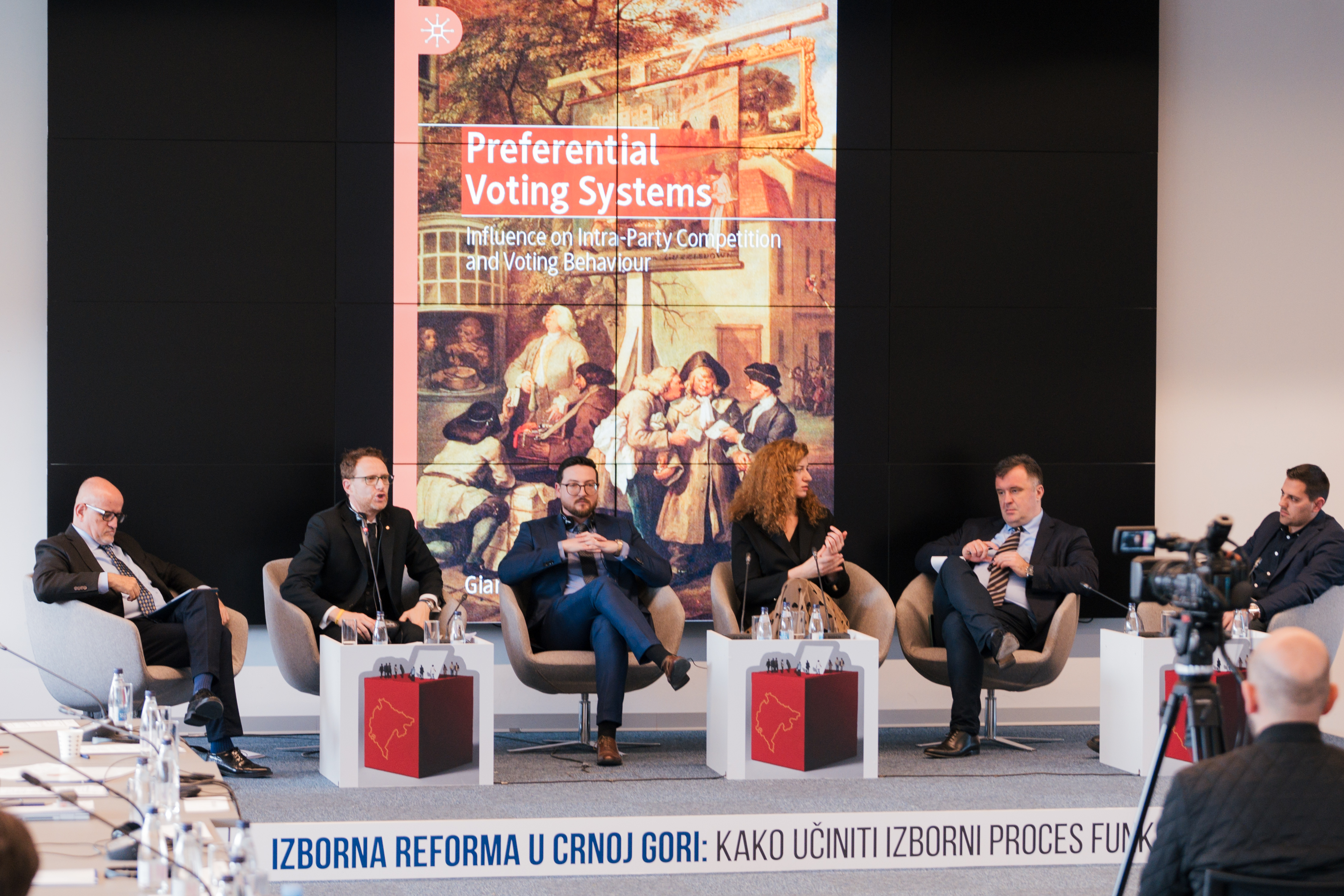
Preferential voting can provide greater rights and greater power to voters, and the electoral system in Montenegro should be adjusted following the Kosovo model and allow that within the list each voter can use up to five preferential votes.
This was announced at the panel "Changes to the electoral system: Open lists, gender quotas, candidate selection for MPs," within the conference "Electoral reform in Montenegro: How to make the electoral process functional?", which we organized with the support of the British Embassy Podgorica.
The President of the CeMI Board of Directors, assistant professor at FPN and deputy president of the Global Network of impartial election observers, assoc. prof. Dr. Zlatko Vujović, believes that when electoral reforms are concerned, all the best from the existing system should be preserved and supplemented with something that would give it a new quality.
"At CeMI, we advocate retaining the good elements of the existing system, and improving the bad ones. The high degree of proportionality, thanks to the fact that Montenegro is one electoral unit, in which all mandates are distributed, is a great value of the existing system, and that should be retained. The quality model of minority representation, i.e., positive discrimination, should be preserved and the existing concept of gender quotas improved," said Vujović.
At CeMI, they advocate that the existing system be adjusted in such a way that it enables the voter within the same candidate list to use up to five preferential votes, for up to five candidates.
"He does not have to, but can use up to five. This will avoid a potential problem with a significant number of invalid ballots. The order within the list will change based on preferential votes won by candidates, so those who get the most preferential votes will also be elected. To prevent potential destabilization of parties, i.e., using elections to question the position of party leaders, the first place on the list can be 'locked', meaning that no vote is cast for the first candidate, but he is elected if the party gains at least one mandate. This alleviates the fears of party leaders. On one hand, it is a secure position for the party leader, and on the other hand, parties still have partial control because they determine who the candidates on the list are," explained Vujović.
The Kosovo model allows for effective functioning of quotas and has, as he added, promoted democratization within political parties.
"It is important to say that this model facilitates agreements on coalition appearances because who will be elected from the list depends on which candidate won more preferential votes, and not from which party, or on which position on the list they are. Also, it is necessary to allow individual candidacies. To prevent large vote splitting, candidates can also be treated as a cumulative list, following the example of minority parties, from which they would be elected but there should be a threshold condition for such candidates, for example that the result of an individual candidate must contain the d’Hondt quotient, and not only the result of the cumulative list. Also, it is necessary to consider the introduction of deposits for parties and individual candidates to prevent the registration of 'adventurous' candidates/parties who have no support but clog the system with candidacies. The deposit would mean they lose the deposited amount if they do not win a certain minimum percentage of votes," said Vujović.
Montenegro is, as he said, territorially a small country, where with small resources every part of the territory can be reached.
Member of the Venice Commission, professor at FPN and member of the Civic Council prof. dr Srđan Darmanović, explained that Montenegro has a fragmented parliament, a proportional system that is special in itself.
"It is very interesting that in our system there is no cost to parties joining pre-election coalitions. There is no graduated electoral threshold, nor any prescribed post-election loyalty to coalitions. Parliamentary clubs in parliament only partially reflect the electoral result published on election day. So pre-election coalitions in our system are not an expression of ideological, program grouping, but mere electoral transport means to reach the threshold of three percent and enter Parliament," explained Darmanović.
He believes that the proportional system brought a certain stability, contributed to easier opportunities for minority participation and theoretically women’s participation.
"This system has brought a certain stability of governments. Considering its good and bad sides, I assume we will mostly witness its reform, and not radical replacement," is Darmanović’s opinion.
Even with the open list system, as he said, parties remain controllers of the offer on the lists.
"Those who are not on the list cannot be voted for. In the majority system, you can run yourself. It has other drawbacks. Here, however, only those who are elected within the party will run. That order may be changed in elections. I think coalition politics will remain the same and open lists will not change it significantly," believes Darmanović.
Former Minister of European Affairs, member of BIEPAG and member of the Civic Council Jovana Marović emphasized that she unconditionally supports open lists.
"Closed lists and gender quotas have brought us formally greater participation of women in decision-making processes, but not substantial. The current quotas of 30 percent are less than the legal minimum in any European Union country. We currently do not have that legal minimum respected in Parliament either. The problem is not a patriarchal environment, but the way politicians perceive women in politics. Also, women when in responsible and powerful positions do not do enough for women’s rights," believes Marović.
Currently, the Montenegrin Parliament has 28 percent women, and the legal minimum is 30 percent.
"Quotas as such are not enough and do not ensure that we have the legal minimum. I believe open lists contribute to fair political competition. Women need to fight for their, that is, our rights, either this way or not at all," is Marović’s message.
According to her, quotas must be 50 percent, women must be high on the open lists and that can be legally regulated.
"I am not optimistic that this electoral reform will bring anything new and revolutionary because we are racing against time, and we will go for the bare minimum just to put that string," Marović’s opinion.
Professor at the Faculty of Political Sciences at Sapienza University prof. dr Gianluca Passarelli believes there is no ideal electoral system and terms suggesting that open lists would lead to an ideal situation should be avoided.
He thinks that in a divided party preferential voting will double that status, and if the party is disciplined preferential voting will do no harm.
"I will not say that preferential voting is good or bad, only that it reflects differently in different circumstances. He believes Montenegro can go in that direction, but with several warnings. Montenegro must be careful about some things. Since open lists will increase competitiveness within the party, it will highlight the use of money. You will need money to compete with each other. Imagine you need to compete with people from Žabljak to Ulcinj. You have to be competitive and focus on big cities, which means you are less represented in some areas. The positive aspect is that you have responsibility," said Passarelli.
With open electoral lists, as he explained, intra-party competition will increase.
Head of the Democracy and Elections Department at ENEMO Pierre Peytier said that when thinking about changes to the electoral system, one should not be afraid of democratic experiments.
"We must see democracy as a process, not a goal in itself. That is why it is important to consider learned lessons, takeaways, but also context. When talking about the context of Kosovo and the concept of open lists, the idea was to give greater power to voters, limit closed party lists, and have greater flexibility. This definitely works, but in a certain context," said Peytier.
He believes that open lists can be organically incorporated into the existing proportional representation system in Montenegro.
"Now in Kosovo no one questions this system, on the contrary, we have expanded this principle and we no longer have five, but 10 candidates represented on the open list," said Peytier.
He explained that long vote counting affects public trust in results.
"When you have fast counting, fast announcement of results, the level of trust is higher because there is more transparency. When there is a long period between voting day and official results, voters start to wonder why it takes so long, what is happening, what political parties are aiming for," said Peytier.
In Montenegro, with five preferential votes, if counted at the polling stations themselves, provided the commission members are adequately trained, it should not be a challenge that is impossible to overcome.