The Anti-Corruption Strategy and the Action Plan for Chapter 23 are good and ambitious documents, but frequent amendments to laws adopted through accelerated procedures, as well as the absence of verdicts in high-level corruption cases, show that there are still no visible systemic effects that would strengthen an anti-corruption culture and public trust in institutions.
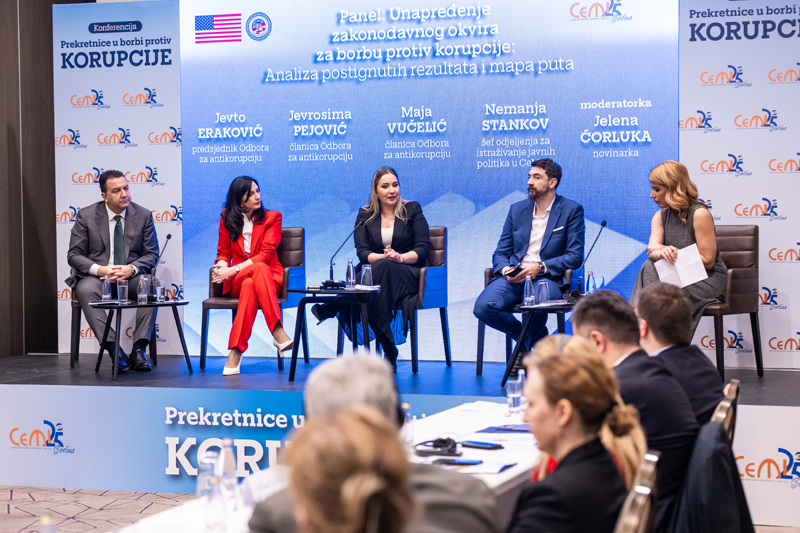
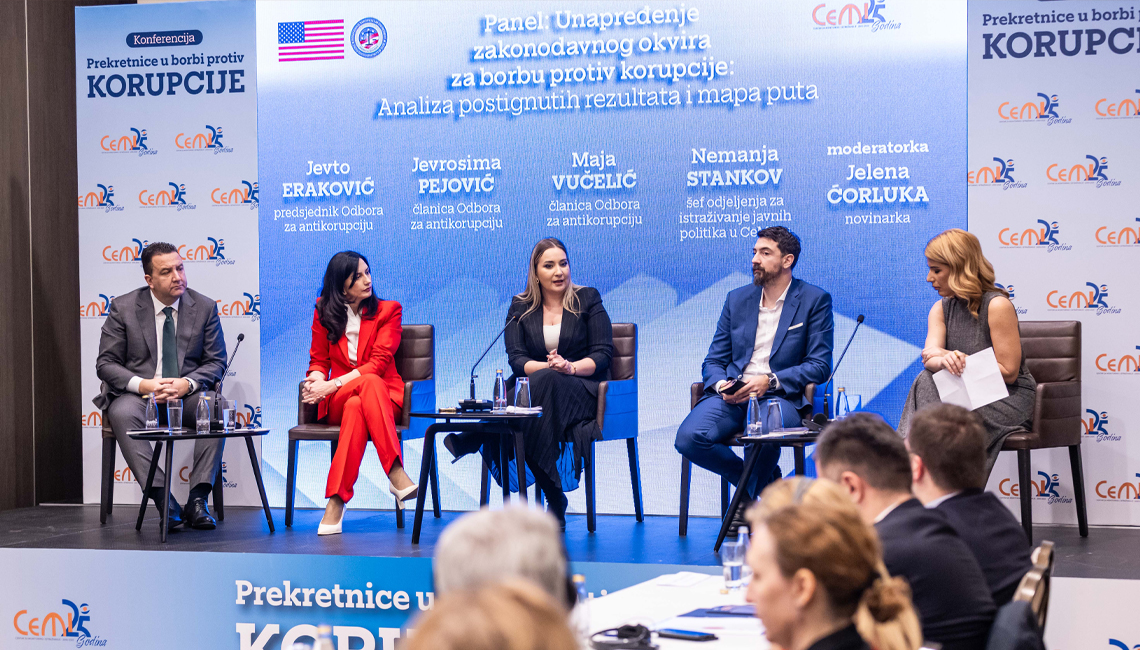
This message was delivered at our conference “Turning Points in the Fight against Corruption,” where the Report on the Implementation of Anti-Corruption Policies and Reforms in Montenegro for the period 2024–2025 was presented.
Nemanja Stankov, Head of the Public Policy Research department at CeMI, said that “in the previous period, an ambitious plan was adopted through the Anti-Corruption Strategy and the Action Plan for Chapter 23, but a large number of key legislative solutions are still pending. This particularly applies to the new Law on the Prevention of Corruption and the first Law on the Protection of Whistleblowers,” Stankov stated.
He recalled that the Law on the Financing of Political Entities and Election Campaigns is the only one that has been amended, but that it is still not fully aligned with the recommendations of GRECO and ODIHR, as confirmed by the European Commission.
Stankov said that “Montenegro will likely complete the planned legislative processes, but it would be unrealistic to expect that the mere adoption of laws by the end of 2026 will lead to real and measurable changes in the system for combating corruption.”
He also warned about the problem of frequent amendments to laws adopted through accelerated procedures, noting that the Law on the Prevention of Corruption was adopted in June last year, and that work on a new version began only five months later.
“Such a practice calls into question the quality of legislative solutions and their long-term application,” he said.
Speaking about the Agency for the Prevention of Corruption (APC), Stankov noted that quantitative progress in the Agency’s work is visible, but that it does not result in stronger compliance with legal obligations.
“The APC operates with about 50 percent of its envisaged capacity, with a chronic problem of an uncertain budget, which prevents serious planning and more efficient work,” Stankov said.
He also problematized the prolonged failure to appoint a director of the APC with a full mandate, assessing that legal solutions allow for an extended acting-director status, which weakens the institutional stability of the Agency.
“Court proceedings in high-level corruption cases, which often end in acquittals or lengthy trials, significantly affect the public’s negative perception of the functioning of the judiciary,” Stankov said.
“This does not necessarily speak to the quality of the judiciary, but it clearly affects citizens’ trust in the system,” he emphasized.
Regarding the National Council for the Fight against Corruption, Stankov stressed that it is necessary to open its work to the public.
“If the Council has a coordinating role in key anti-corruption processes, then it is unacceptable for its work to remain non-transparent and difficult for the public to access,” he said.
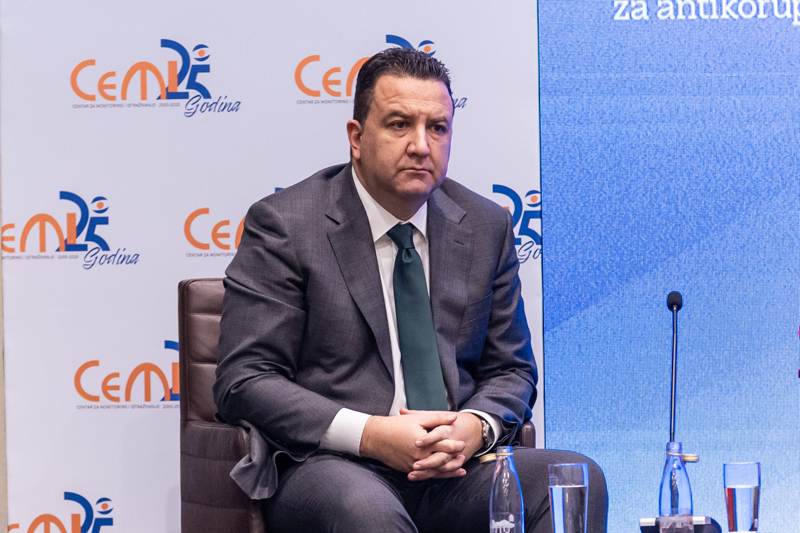
Jevto Eraković, President of the Parliamentary Committee on Anti-Corruption, stated that “Montenegro’s accession to the European Union remains a programmatic goal of the Democratic Party of Socialists, but strengthening domestic institutions and consistent, non-selective application of the law is an even more important task for the state.”
He emphasized that the DPS will, as before, support all legislative solutions and reform processes that lead toward Montenegro’s membership in the European Union.
“However, it is crucial that, in parallel with this process, we strengthen our institutions and demonstrate that laws are applied equally to all, without exceptions,” Eraković said.
According to him, institutional strength and non-selective action represent the foundation of a functional state and a prerequisite for real, not merely formal, reform progress.
“That is what benefits Montenegro, regardless of the dynamics of European integration,” Eraković concluded.
He assessed that the establishment of new special courts and institutions in Montenegro is often motivated by political interests rather than a genuine need to strengthen the rule of law.
“The purpose of inventing new institutions is often for them to become a political weapon in the hands of those who want to achieve certain goals. We would be the first to support their establishment if they were truly independent and free from political influence,” Eraković said.
He warned that the security sector is increasingly being placed under the control of a single political group, while judges and prosecutors are exposed to strong political and media pressure.
As an illustrative example, he cited the process of electing judges to the Constitutional Court.
“Today, the key question for candidates is whether they would fully implement the decision in the ‘coup d’état’ case. If they state that they would act in accordance with court decisions, they do not receive the support of the parliamentary majority. If they say otherwise, they become acceptable candidates. This is devastating for the highest judicial institution in the country,” Eraković said.
According to him, Montenegro can move forward only when the judiciary and prosecution are freed from political pressure.
“We have never had greater political pressure on the judiciary than today. Under such circumstances, the story of the rule of law is only beginning, instead of being completed,” he assessed.
“Our strategic goal must be genuine rule of law, not formal EU membership,” Eraković emphasized.
Jevrosima Pejović, a member of the Committee on Anti-Corruption, said that the fight against corruption requires the building of a functional system that provides citizens with dignity and trust in institutions.
“It is important to understand the circumstances in which decisions are made,” Pejović said, reminding that laws and the Agency for the Prevention of Corruption have the role of reminding officeholders that laws apply equally to everyone.
“The task of the state is not only to sanction corruption, but to build a system that enables freedom of choice without pressure and fear, and good laws are mechanisms for protecting dignity-both of citizens and decision-makers,” Pejović said.
She criticized the practice of adopting laws through accelerated procedures without substantive dialogue, recalling the experience with the Law on the Prevention of Corruption, which, as she noted, clearly had serious shortcomings already at the moment of adoption.
“We are politicians paid to talk. When dialogue is absent, when there are no interlocutors, we get poor solutions and bear the consequences,” she said.
Speaking about European integration, Pejović stressed that “we do not have the luxury of excluding people who have knowledge and experience. If we are all at the table-the Committee on Anti-Corruption, the Committee on Security, and the Committee on Political System we will get better solutions and fewer political conflicts in the plenary hall,” she said.
Pejović expressed confidence in the employees of the Agency for the Prevention of Corruption, emphasizing that institutions rest on “ordinary people” who work every day under complex and often difficult conditions.
“It is important that these people know we see them and that we are aware the system does not exist without them,” she said.
Referring to the judiciary, Pejović warned that due to individual cases of corruption, a large number of judges and prosecutors who perform their duties honorably and professionally are often marginalized, which further undermines public trust in institutions.
“Our task is not to suspect all judges a priori, but to identify weak points in the system and responsible individuals,” Pejović emphasized.
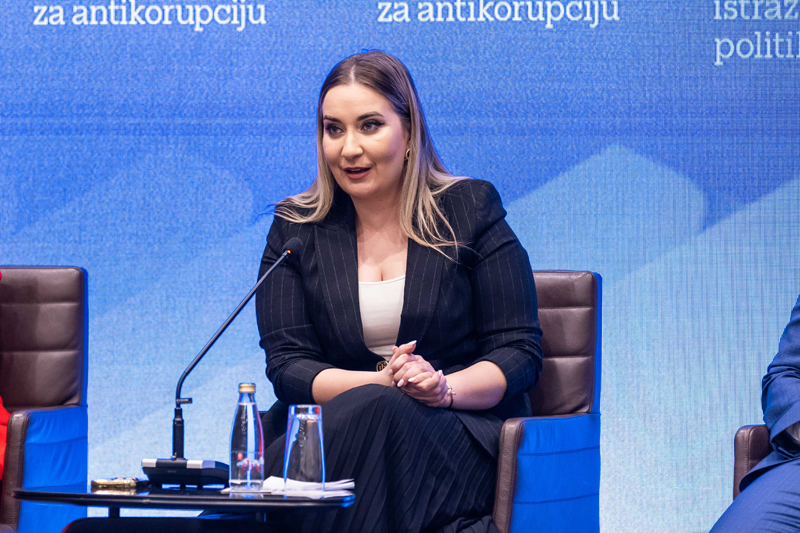
Maja Vučelić, a member of the Committee on Anti-Corruption, assessed that “Montenegro is entering the most demanding phase in the area of the rule of law, bearing in mind the closure of Chapters 23 and 24, which represent the foundation of the European integration process.”
“Montenegro has entered a phase in which the fight against corruption is no longer reduced to reports alone, but where there are concrete investigations and the work of independent institutions. Now, well-founded and final court verdicts are rightly expected,” Vučelić emphasized.
She stressed that full cooperation among all three branches of government-legislative, executive, and judicial-is necessary in order to create a genuine atmosphere of the rule of law.
“Parliament must adopt quality laws, the Government must ensure technical and logistical conditions for the work of the judiciary, and the judicial branch must demonstrate accountability, efficiency, and vision,” Vučelić said, reminding that court proceedings are often postponed due to a lack of basic technical conditions.
“With the new law, the Agency for the Prevention of Corruption must be given greater powers, especially when it comes to monitoring the assets of public officials. We cannot speak of fighting high-level corruption if officials who fail to declare assets face only minimal fines,” Vučelić said.
She also pointed to the need to establish an up-to-date and accurate register of public officials, emphasizing that the fight against corruption does not depend exclusively on laws, but also on the technical readiness of institutions.
Speaking about the Agency for the Prevention of Corruption, Vučelić recalled that the law provides for the allocation of 0.2 percent of the budget for its work, and that funds have been secured through the budget reserve, but that the key issue remains the Agency’s capacity to use them.
“The appointment of the Agency’s director with a full mandate is of crucial importance, particularly due to coordination with GRECO, ODIHR, and United Nations recommendations. If this does not happen, the Committee on Anti-Corruption has an obligation to react,” she emphasized.
Vučelić added that work is being carried out in parallel on the Law on the Protection of Whistleblowers and the Law on the Confiscation of Illegally Acquired Assets, with the support of the Council of Europe, stressing the importance of avoiding legal gaps that could produce counterproductive effects.
In conclusion, Vučelić said she is confident that Montenegro can fulfill its obligations from the European agenda, but that this process must not be burdened with identity and political issues that divert attention from essential reforms.
“Our task is clear-the rule of law must become a reality, not just a political phrase,” Vučelić concluded.
The conference was organized within the framework of the project “Raise Your Voice: For a Corruption-Free Montenegro,” implemented by CeMI with financial support from the Bureau of International Narcotics and Law Enforcement Affairs (INL) of the U.S. Embassy in Montenegro.