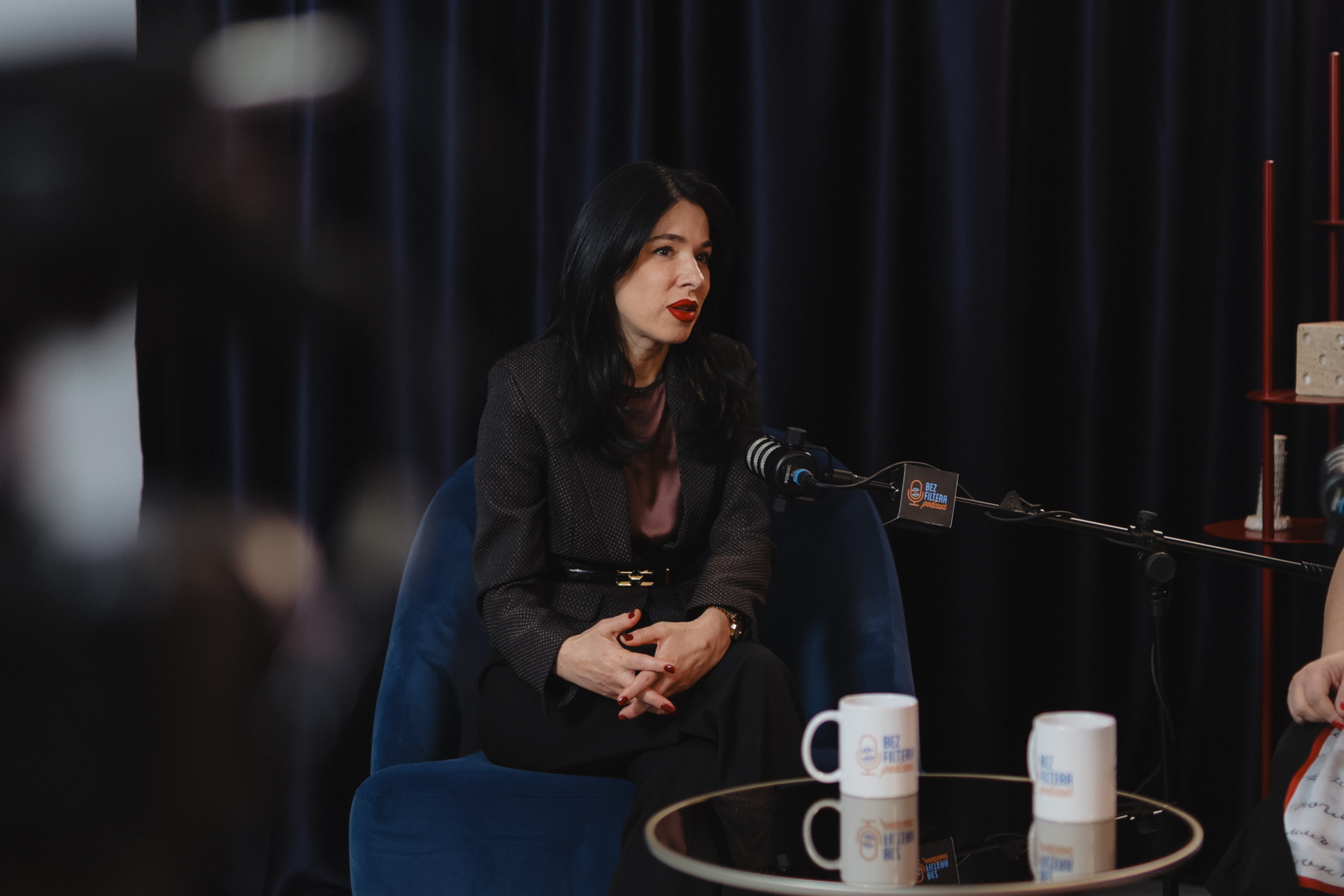
The online space has become a battlefield for political struggle where women are the most frequent targets of attacks, driven by deeply rooted patriarchal stereotypes regarding their role in society. Consequently, violence is increasingly used as a tool to silence them and discourage their public engagement.
This was assessed during the fourth episode of the podcast "Bez filtera" (Without Filter), produced by the Centre for Monitoring and Research (CeMI).
Zoja Bojanić Lalović, a member of the DPS Presidency and a Member of the Parliament of Montenegro, stated that online violence represents an increasingly prominent problem, especially for women in politics who are often targeted because of their views and public actions.
"Online violence is a powerful weapon in the hands of individuals trying to silence the voices of women," said Bojanić Lalović, adding that the view that politics is primarily a "man's job" is still present in Montenegrin society, while traditional roles are imposed on women.
She emphasized that women who are willing to criticize, demand answers, and advocate for social change are the most frequently exposed to attacks.
"These are often people who have no other arguments to fight against a specific political stance, so they resort to online violence as a way to silence a woman or a female politician," Bojanić Lalović noted.
She believes it is vital for women to have strength and faith in what they are fighting for.
"You cannot remain immune, but you must realize that this is one of the poor instruments of political struggle. It is the price of truth, but that does not mean we shouldn't fight against it," Bojanić Lalović said.
She also pointed to the broader social context, noting that women often back away from topics that provoke harsh reactions, such as corruption and party-based employment.
"In a society still burdened by traditional norms, women are insufficiently empowered to withstand attacks that degrade them both as politicians and as women," said Bojanić Lalović.
A particular challenge, she highlighted, is the reaction of those closest to them.
"None of us can completely detach ourselves from worrying about our children or parents. They do not navigate that [online] space as we do and often experience it much more severely," said Bojanić Lalović, adding that she has personally experienced instances where negative comments affected her family.
Speaking about politics, Bojanić Lalović assessed that it can have a noble purpose if used to improve the quality of citizens' lives.
"If you use politics as a tool for social change in areas you are familiar with, then it makes sense. Otherwise, it becomes a means of personal affirmation," said Bojanić Lalović.
She emphasized that "knowledge is the only authority," and that it is important for politicians to engage in fields where they have experience and competence.
She also reflected on cooperation among women in politics, highlighting the necessity of overcoming party divisions. "A good idea must not be rejected simply because it comes from another party. That is what hinders progress and causes initiatives to fail," she concluded.
Bojanić Lalović stated that the fight against online violence and hate speech is crucial for creating a society in which women will have equal opportunities to participate in political life.
Marija Blagojević, a researcher and gender equality expert from the UNDP, assessed that online violence against women in politics is not an isolated phenomenon, but a consequence of deeply rooted patriarchal patterns, stereotypes, and social norms.
"Online violence is just one form of violence. At the root of all types of violence, including online violence, are patriarchal patterns and stereotypes, which are the hardest to change," said Blagojević, noting that changing such norms requires long-term effort from individuals, institutions, and society as a whole.
Blagojević pointed out that even high-quality laws and international conventions are not enough if a change in consciousness is absent.
She also stated that people are extremely significant, as we all carry certain attitudes and values; therefore, it is vital that those who develop and implement laws also understand the principles of gender equality.
Speaking about violence against women in politics, she recalled a UNDP study which showed that nine out of ten female politicians in Montenegro have experienced some form of discrimination, and seven out of ten have experienced some form of violence, emphasizing that women are exposed to violence both within and outside of their political parties.
She recalled a recently published UNDP study on attitudes and perceptions regarding gender equality, conducted as part of the EU project "United in Gender Equality," which shows that half of all citizens believe men are naturally better leaders, even though nearly 70 percent simultaneously support equal representation of women in government.
"This clearly demonstrates how prevalent stereotypes still are in society," Blagojević pointed out.
As an illustration of deeply rooted patterns, she cited the issue of inheritance, where women are legally equal but often renounce their property due to social pressure.
"The pattern is so strong that something which is a legal right becomes socially unacceptable," said Blagojević.
She also pointed out the difference in how public debate is conducted regarding men and women.
"When it comes to men, discussions are mostly held at the level of arguments. Regarding women, comments are often made about their appearance, marital status, and personal characteristics instead of the views they present," Blagojević stated.
She specifically warned about the phenomenon of so-called "benevolent sexism," where women are "defended" against criticism simply because they are women, which, as she says, further relativizes their equal role in the public sphere.
Blagojević emphasized that education is key, but the data indicates there is still significant room for progress.
"The study showed that 65 percent of public administration employees have never undergone training in the field of gender equality, although that percentage was even higher in the past," said Blagojević.
She added that online violence is further complicated by the fact that the digital space is evolving rapidly, including the influence of artificial intelligence, which can reproduce existing social biases.
Regarding the legislative framework, Blagojević highlighted that a new Law on Gender Equality is in preparation, which should strengthen sanctions and improve the application of gender equality principles within institutions.
"Sanctions should be adequate and have a preventive effect. It is equally important to raise awareness and connect institutions, because no single institution can solve the problem of violence alone," Blagojević stated.
She believes that violence against women, including online violence, is part of a broader social problem that requires a systemic approach and a long-term change in social patterns.
"If we do not recognize the root of the problem, we can hardly expect to resolve its consequences," Blagojević concluded.
The podcast was moderated by Jovana Marović, a member of BiEPAG.
The fourth episode of the podcast "Bez filtera," titled "Women Louder than Stereotypes and Misogyny," was realized as part of the project "Equal in Public – For a Safe Public Space in Montenegro," implemented by CeMI with the financial support of the Ministry of Human and Minority Rights. The views expressed in the podcast do not necessarily reflect the views of the Ministry of Human and Minority Rights.