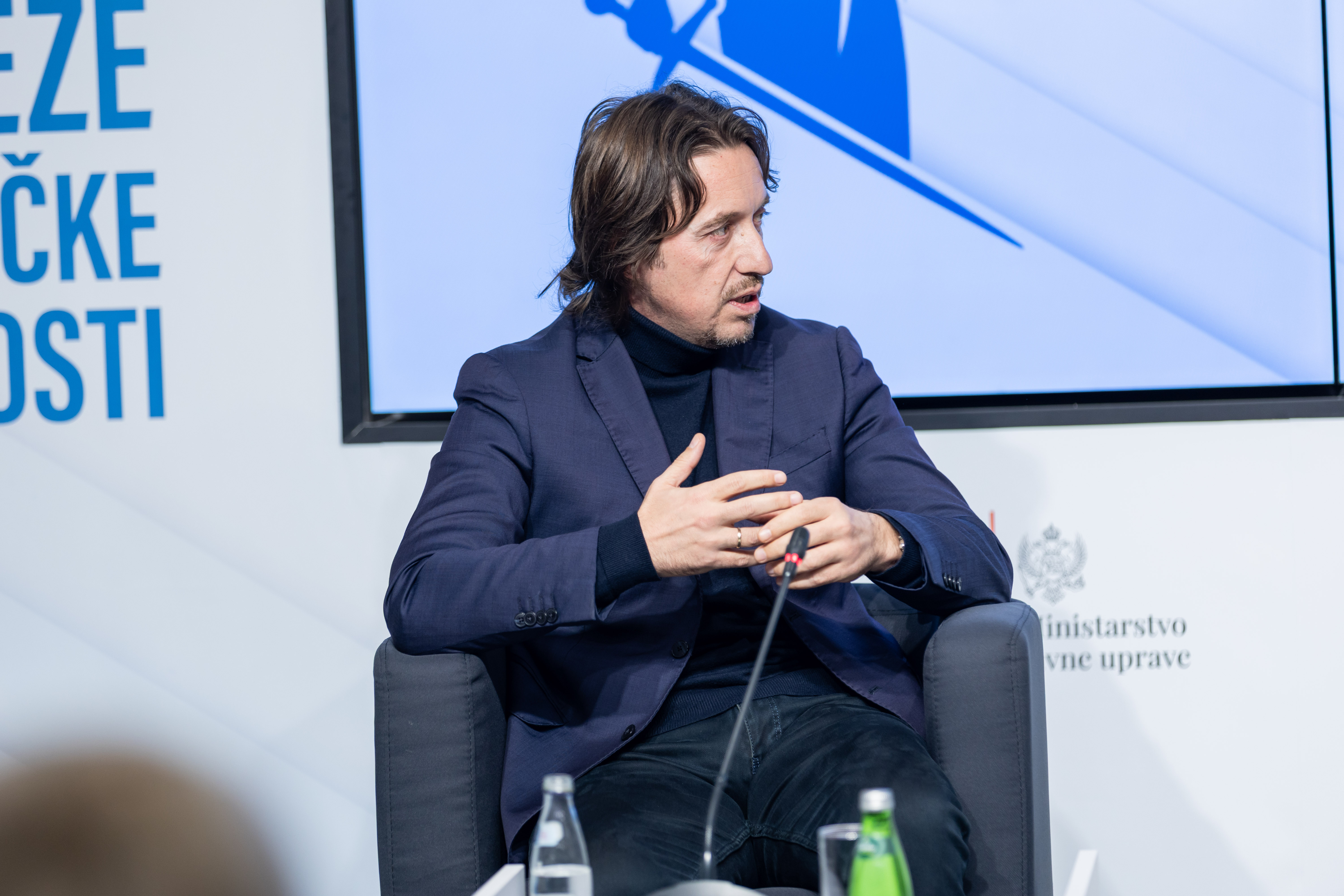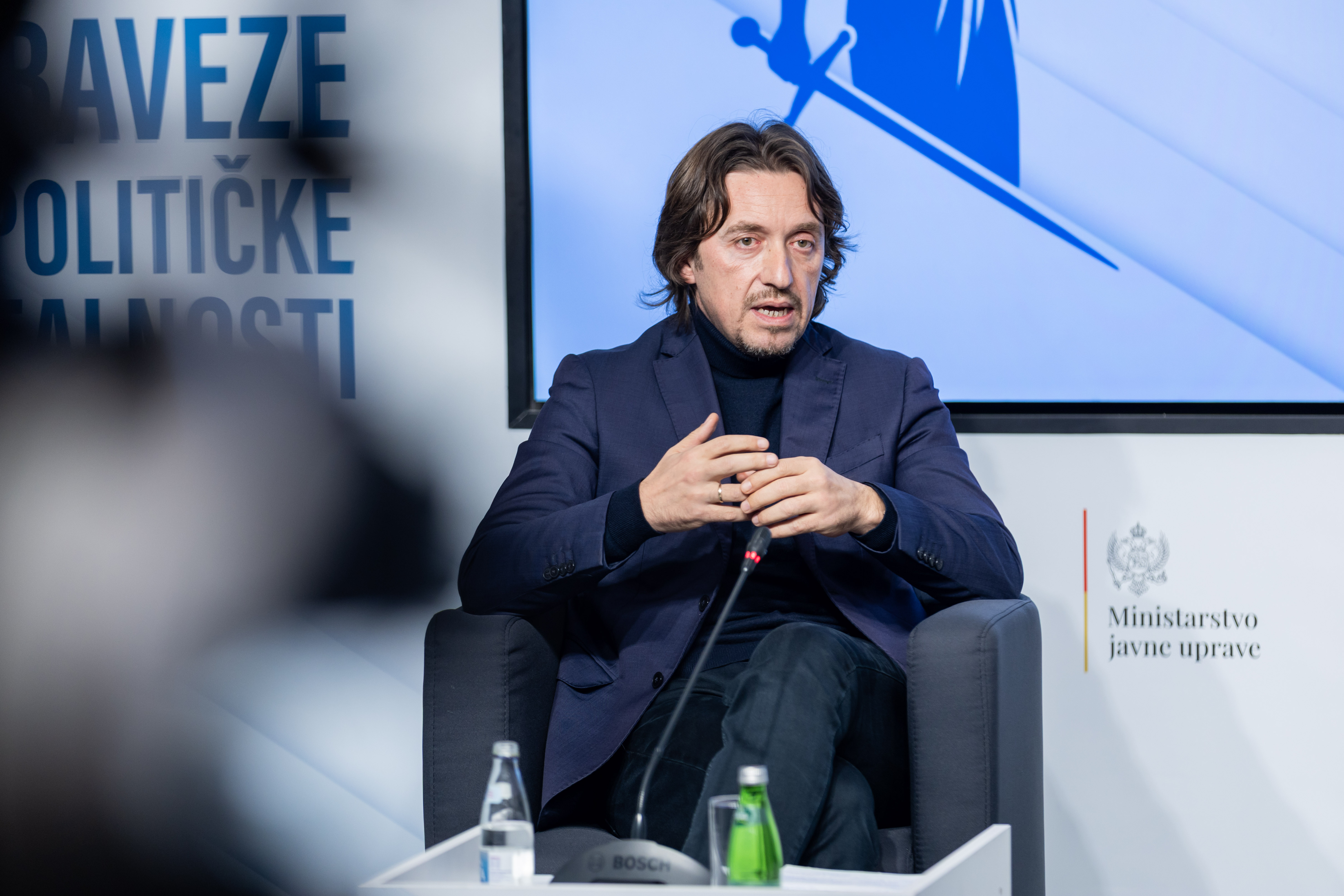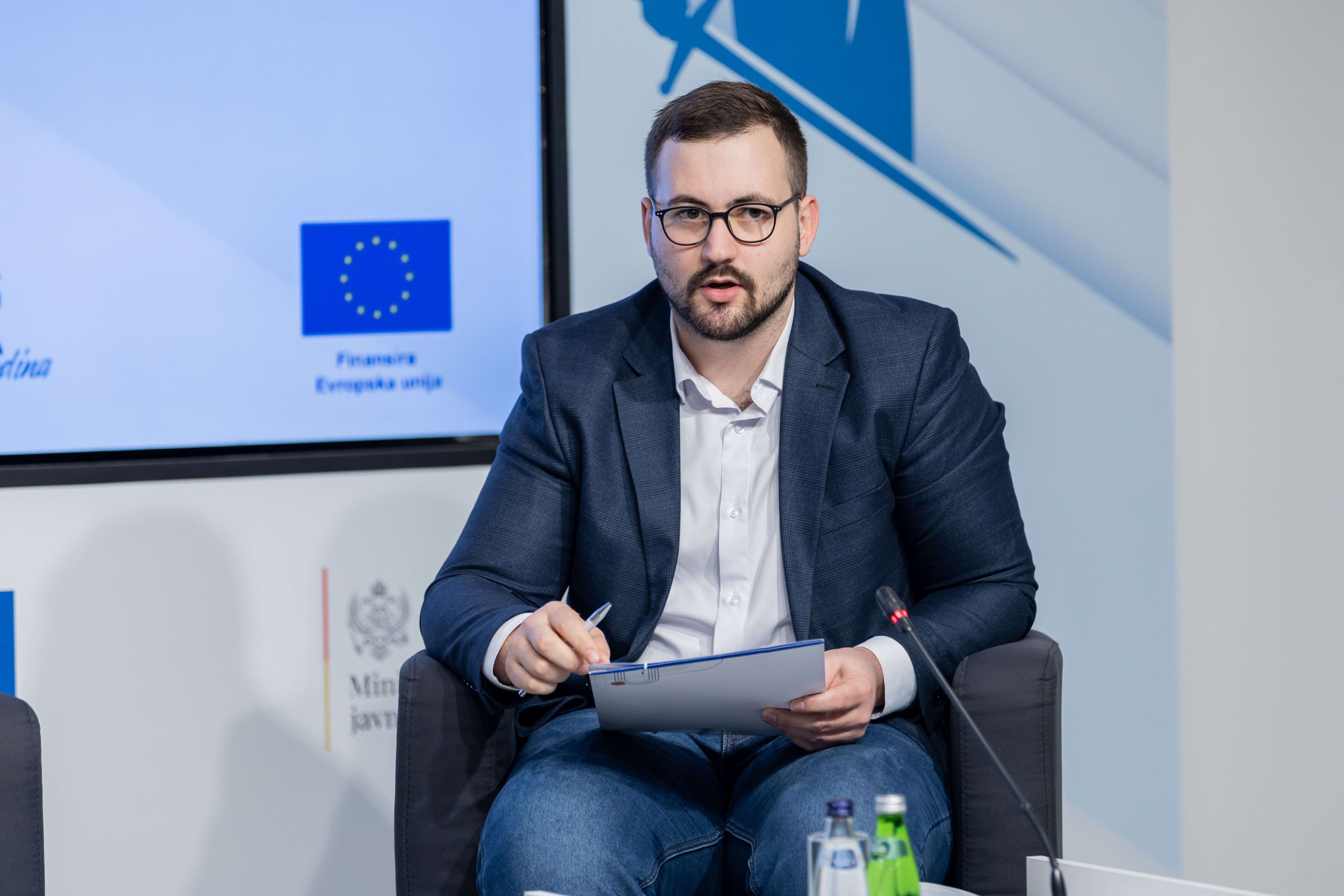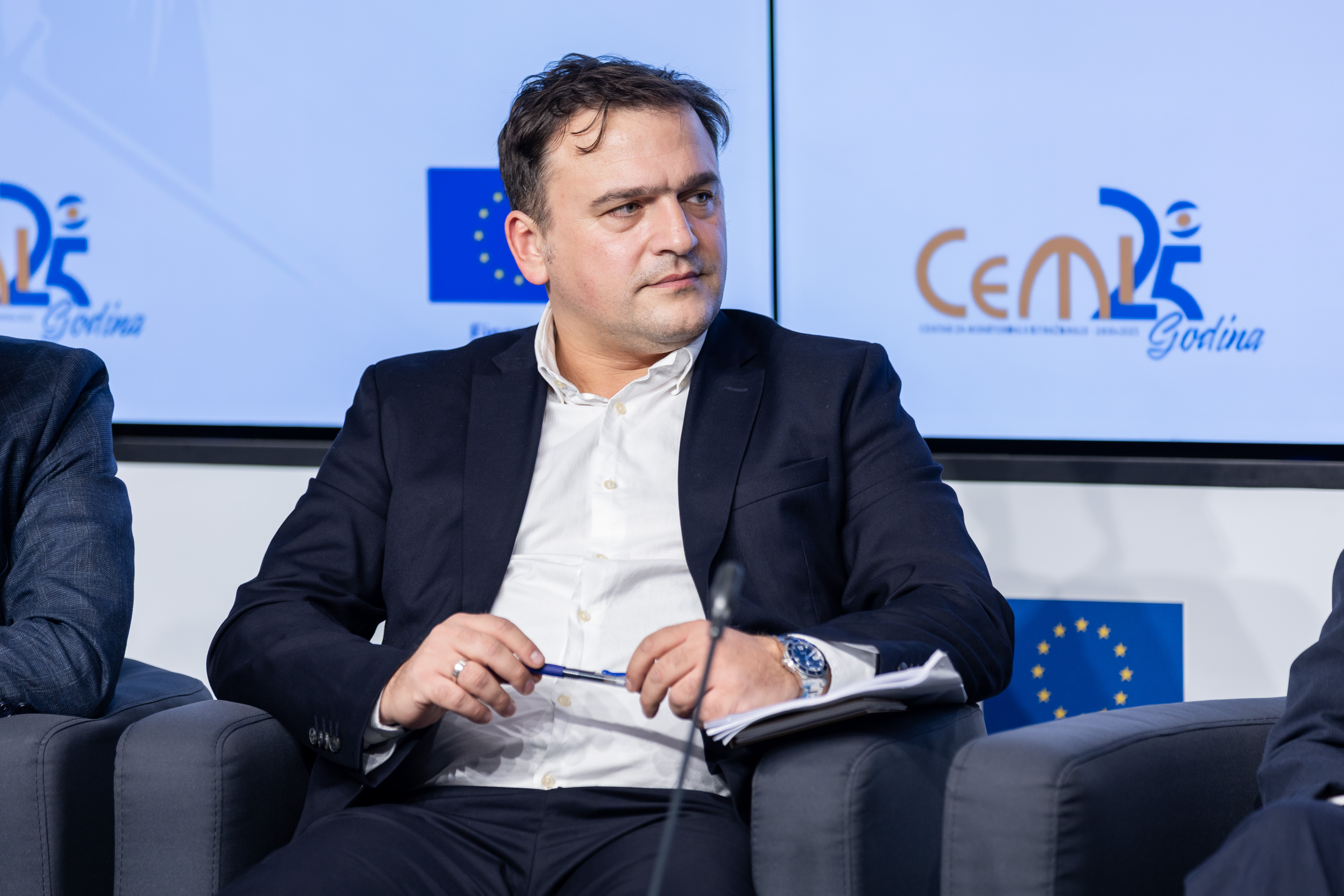
The Constitutional Court of Montenegro is facing political pressure and a lack of openness, making urgent reform necessary, along with the prompt election of judges, strengthening of autonomy, and the establishment of clear procedures, so that the institution can independently protect constitutionality and human rights.
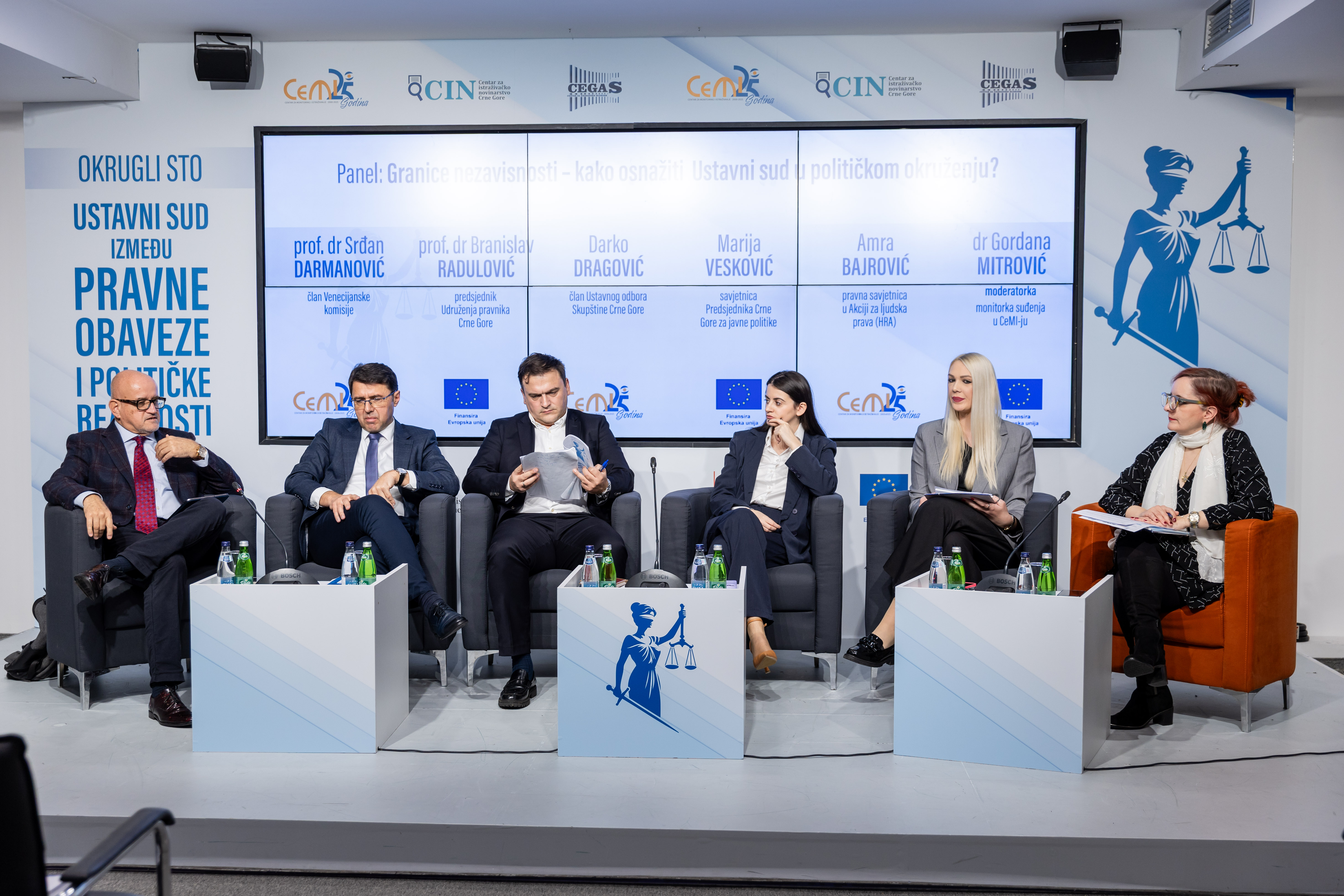
This was stated at our roundtable discussion titled “The Constitutional Court Between Legal Obligation and Political Reality.”
State Secretary at the Ministry of Justice, Sergej Sekulović, said that the past year had been extremely demanding in terms of the work of both the Constitutional Court and the Ministry of Justice, particularly due to the recommendations of the Venice Commission, which obliged the state to amend certain legal provisions.
According to him, work on the legislative amendments has been completed, and the proposals have already been submitted to the European Commission and the Venice Commission for opinion.
“I expect the recommendations of the Venice Commission to arrive in mid-December,” said Sekulović.
He believes that the most sensitive recommendation is the one that seeks to ensure the continuity of the work of the Constitutional Court in situations where the Parliament does not elect new judges and the mandate of individual judges expires.
“The Constitution clearly states that judges’ mandates last 12 years. However, it is possible to imagine a scenario in which Parliament, for whatever reason, does not elect judges, which could paralyze the work of the Constitutional Court. The Court would formally exist, but would not be able to perform its constitutional competences, from the protection of human rights to constitutional review and oversight of the electoral process,” Sekulović said.
For that reason, he explained, the working group proposed a solution under which judges’ mandates would be extended only if the failure to elect new judges would result in the loss of quorum and institutional blockage. He added that there were differing opinions on this provision, and that the final word would be given by the Venice Commission.
Zlatko Vujović President of the governing board of CeMI, reminded that the organization has been dealing with judicial reform and rule of law issues for nearly two decades, cooperating during that period with numerous state institutions.
Although communication with institutions was occasionally accompanied by certain tensions, cooperation, he said, always existed.
“However, during the preparation of this study, we encountered an experience we had never had before. The Constitutional Court proved to be the most closed institution CeMI has ever attempted to cooperate with,” said Vujović.
He stated that the Court formally responded to the request for access to information, which is its legal obligation, but refused to participate in the research, declined interviews, and did not provide comments on the draft study prior to publication.
“Their lack of cooperation is not an administrative detail. It is a message. It shows the condition of an institution that, by its very nature, should be the most open and transparent,” said Vujović, adding that such an attitude reflects “weakness, political vulnerability, and insecurity in defending its own decisions.”
He reminded that the Constitutional Court should represent “the last pillar of protection of human rights and constitutionality,” but that practice shows serious deviations.
Vujović pointed out that the Court has never used the possibility to initiate proceedings ex officio or to warn Parliament about unconstitutional laws — a mechanism that in developed legal systems strengthens institutional autonomy.
He also emphasized problems in dealing with electoral cases, which are often delayed or not resolved at all, creating, as he said, a “dangerous institutional vacuum.”
“The process of electing judges is the most visible and most dangerous point of political influence,” said Vujović. He recalled that between 2020 and 2023, Parliament attempted four times to elect judges, unsuccessfully due to political blockades, resulting in the Court losing quorum and becoming effectively paralyzed.
He cited as particularly dramatic the case of Judge Đuranović, in which, according to CeMI and the Venice Commission, Parliament assumed the jurisdiction of the Constitutional Court by independently deciding on the termination of a judge’s mandate. “This is a direct encroachment of the legislative branch into the jurisdiction of the Court,” Vujović warned.
He added that political pressure is not the only problem, as the Constitutional Court has “only half of the required number of employees” and depends on other institutions for staffing. Insufficient funding further undermines its independence and efficiency.
Vujović stressed that changes are necessary and that the recommendations of the study and the Venice Commission represent an important step toward more stable decision-making by the Constitutional Court. Nevertheless, he emphasized that substantial reform likely cannot be expected before Montenegro’s accession to the EU.
“Montenegro needs a Constitutional Court composed of authorities who believe in the Constitution more than in the political will of those who elect them; a court that does not shy away from the public and does not wait for signals, but follows principles,” Vujović concluded.
During the presentation of the report and key findings of the study on the Constitutional Court, Head of CeMI’s Legal Department, Damir Suljević, emphasized that the institution has long been balancing between the speed of decision-making and the quality of reasoning, “which the current model of work can no longer sustain.”
He stated that the third chapter of the study, which analyzes efficiency, institutional stability, and the protection of constitutionality, points to long-term problems in the Court’s work.
“At the beginning of the reporting period, we had a large number of unresolved cases, and the percentage of resolved cases compared to received cases fluctuated significantly, from 52.5% in 2018 to 149.1% in 2022,” said Suljević.
He warned that the Constitutional Court, as a body whose decisions have direct consequences for human rights, institutional stability, and political processes, “cannot afford either superficiality or delay.”
According to him, working under pressure creates a dual risk. “Either backlogs will grow, or the quality of reasoning will decline. For years, the first scenario dominated, and now there is a real danger of the second,” Suljević noted.
He also pointed to serious shortcomings in the area of electoral legal protection, especially the “chronic normative absence of clearly regulated deadlines,” even though electoral disputes are inherently urgent. “If they are not resolved in time, they lose their meaning,” Suljević said.
He emphasized that in practice it often happens that appeals against decisions of the State Election Commission are resolved with delays, or that the Constitutional Court rules in a single sentence without detailed reasoning.
“Such an approach complicates the work of electoral bodies, prolongs proceedings, and increases the number of new disputes, while the Court ‘lacks mechanisms that guarantee decision-making within deadlines that would prevent an institutional vacuum,’” Suljević warned.
He noted that the fourth chapter of the study identifies areas that will be decisive for the future functioning of the Constitutional Court. The first priority is the depoliticization of the election of judges.
“The election of judges must not be a point of political blackmail or blockade. The model must include more actors, reduce room for political calculations, and strengthen criteria of expertise and integrity,” said Suljević, adding that the selection mechanism should also be considered at the constitutional level.
The second priority is institutional autonomy. According to the study’s findings, “formal independence is not sufficient if the court does not have control over its own resources — primarily the budget and human resources,” as budgetary and staffing dependence prevents long-term planning.
The third key element is transparency, understood as a mechanism of control and self-discipline rather than a PR issue. The Court, the study states, should clearly explain “criteria for determining priorities, case allocation, and urgency labeling,” thereby strengthening predictability and legal certainty.
The study’s recommendations represent a “coherent package” aimed at making the Constitutional Court more resilient to political crises, blockades, and overload. However, they are not conceived as partial or short-term solutions, but as deep institutional changes.
“The Constitutional Court cannot functionally exist without reforming the election of judges, strengthening internal autonomy, and establishing a clear system of priorities and deadlines. Anything else would be temporary measures that do not address the root problems,” it was concluded during the presentation of the study.
During the panel “Limits of Independence – How to Strengthen the Constitutional Court in a Political Environment?” Venice Commission member Prof. Dr. Srđan Darmanović said that constitutional justice in Montenegro is often viewed technically, primarily through Chapters 23 and 24, even though it is a much broader and more serious issue.
“Of course, without functional constitutional justice there is no progress. Something is being done in this regard, and I believe that for the EU, as the club we want to join, this will be one of the most important elements,” Darmanović said.
He emphasized that constitutional justice and the position of the Constitutional Court will remain decisive conditions for Montenegro’s membership in the European Union.
This, he explained, does not mean that the EU will react to every individual decision, but that issues such as the independence of the Constitutional Court, the method of electing judges, efficiency in work, and financial sustainability will be among the key criteria.
“Sometimes we behave as if the EU will accept us regardless of everything. It is true that we have a favorable geopolitical moment, but the criteria will not be ignored. We will have to show that, if not fully ready on the day of accession, then sufficiently ready to later fulfill the obligations arising from the European system,” Darmanović assessed.
He believes that the issue of the Constitutional Court and constitutional justice will remain at the top of priorities until the end of the process, and even afterward.
President of the Montenegrin Association of Lawyers, Prof. Dr. Branislav Radulović, assessed that the process of electing Constitutional Court judges has been deeply undermined by political influence and that the institution is, as a result, in serious danger of losing credibility and professional integrity.
Speaking about the historical development of the constitutional judiciary, Radulović recalled that the 1963 Constitution of the SFRY established a model that laid the foundations of today’s practice, and that Montenegro has since inherited a long tradition of constitutional protection. Precisely because of that continuity, he said, one would expect such an institution to enjoy a high level of respect.
“If we put this in the context of current events, I have only one word — contamination,” Radulović stressed. He recalled that the constitutional amendments of 2013, adopted with the support of the Venice Commission, aimed to strengthen the credibility of the judge selection process so that it would not be predominantly political.
However, he argues that the contemporary process of public hearings produces the opposite effect. Instead of raising the quality of candidates, in his view, it discourages experts from participating.
Radulović emphasized that the problem is particularly visible with candidates whose references were not known to the professional community.
“It was enough that for some of them you had to search the internet to find out who they were, because they had never published a scientific paper, participated in a scientific conference, or expressed a public professional position,” Radulović said.
Speaking about the current process, Radulović expressed concern that the results would only become visible in a few years, after the “euphoria of European integration” fades and concrete results are expected from the Constitutional Court.
He appealed to Parliament to complete the process of electing judges.
“I am glad that new judges will probably be elected. I appeal for the process to truly be completed, so that the Court can function normally,” Radulović said.
Member of the Constitutional Committee of the Montenegrin Parliament, Darko Dragović, stated that Montenegro must not allow another blockade of the Constitutional Court and that it would be devastating if Parliament once again fails to elect judges.
According to him, the 2013 constitutional amendments reduced political influence over the election of judges, but at the same time opened space for a new constitutional crisis, as politics “seeks ways to retain control over the election and work of the Constitutional Court.”
He particularly emphasized the omission that the Constitution did not precisely define the term “distinguished legal expert,” which, in his opinion, led to the candidacy of individuals without clear references and contributed to a decline in the quality of the judicial function.
Dragović recalled that until 2013 Montenegro had an unwritten but significant practice that the composition of the Constitutional Court always included at least one legal theorist, which strengthened the institution’s authority. That practice was abandoned, and among the current candidates there is not a single legal theorist.
He assessed it as problematic that Constitutional Court judges do not have sufficient professional experience and that in practice constitutional law advisers effectively write decisions, while judges merely confirm them.
Dragović also criticized the quality of public hearings of candidates before the parliamentary committee, noting that MPs often lack adequate knowledge of constitutional law, which opens space for questions unrelated to professional criteria, such as national or party affiliation.
He also pointed to the lack of transparency in the process of electing judges proposed by the President of the state, stressing that the public must have insight into that part of the procedure.
He expressed concern that some current and future Constitutional Court judges may only learn the job during their mandates, which he believes would be harmful both for the protection of human rights and for the overall work of the institution.
Advisor to the President of Montenegro for Public Policy, Marija Vesković, assessed that the election of Constitutional Court judges remains a political process strongly conditioned by the interests of political parties.
She believes this directly affects the perception of independence of the highest judicial instance.
Vesković recalled that public trust in the Constitutional Court is shaped through decisions on constitutional complaints, media portrayals of its work, the actions of political actors in the judge selection process, and the behavior of the candidates themselves.
She emphasized that technical transparency, such as broadcasting hearings before the Constitutional Committee, is not sufficient, because the essence of the process depends on the quality of questions, the way hearings are conducted, and the overall treatment of candidates.
According to her, a decline in the number of applicants is also noticeable, indicating that the procedure has become discouraging for competent and reputable lawyers.
“The position of Constitutional Court judge may be the most prestigious for a lawyer in Montenegro, but under current circumstances it is becoming one of the least attractive,” said Vesković. She explained that candidates are exposed to politicization and media labeling, in which their professional biographies are often reduced to presumed party affiliation, family background, or place of origin.
Speaking about the role of the President of Montenegro in the process, Vesković recalled that the procedure does not formally require public consultations, but that the President nevertheless invited all political parties to talks prior to the parliamentary vote. She believes this step contributes to transparency, since the President’s proposal is not a final decision — the final decision is made by Parliament.
Legal Advisor at Human Rights Action (HRA), Amra Bajrović, warned of serious problems in the functionalization of the Constitutional Court of Montenegro.
“The Constitutional Court is effectively blocked, because decisions are possible only by consensus of all judges. Such a situation is not normal and creates pressure on judges,” Bajrović said.
According to her, the current number of judges does not allow for efficient formation of panels, noting that nine judges would facilitate work and allow, for example, the formation of three panels for constitutional complaints.
Bajrović emphasized that the judge selection process demonstrates the inertia of the legislature and political calculations.
“There were situations where candidates waited up to nine months, committee sessions were postponed, and candidates were discredited with unfounded arguments, even though they met all legal requirements,” Bajrović stated.
She added that the issue of candidates’ judicial experience is often used as an unfounded criticism, even though this requirement is not prescribed either in Montenegro or in the region.
Bajrović warned that further delays in electing new judges threaten the efficiency of the Constitutional Court and Montenegro’s European path.
“If judges are not elected soon, according to our estimates, new members of the Court could be appointed only in March or April of next year,” Bajrović concluded.
The event was organized within the project “Support to Montenegro’s EU Integration – for an Independent and Professional Judiciary as a Key Prerequisite!” implemented by CeMI, in cooperation with the Center for Investigative Journalism of Montenegro (CIN-CG) and the Center for Civil Liberties (CEGAS), funded by the European Union and co-financed by the Ministry of Public Administration of Montenegro.