The revised text of the Law on the Prevention of Corruption received positive assessments without objections, and after review by the European Commission, its final approval is expected, with adoption anticipated by June 30.
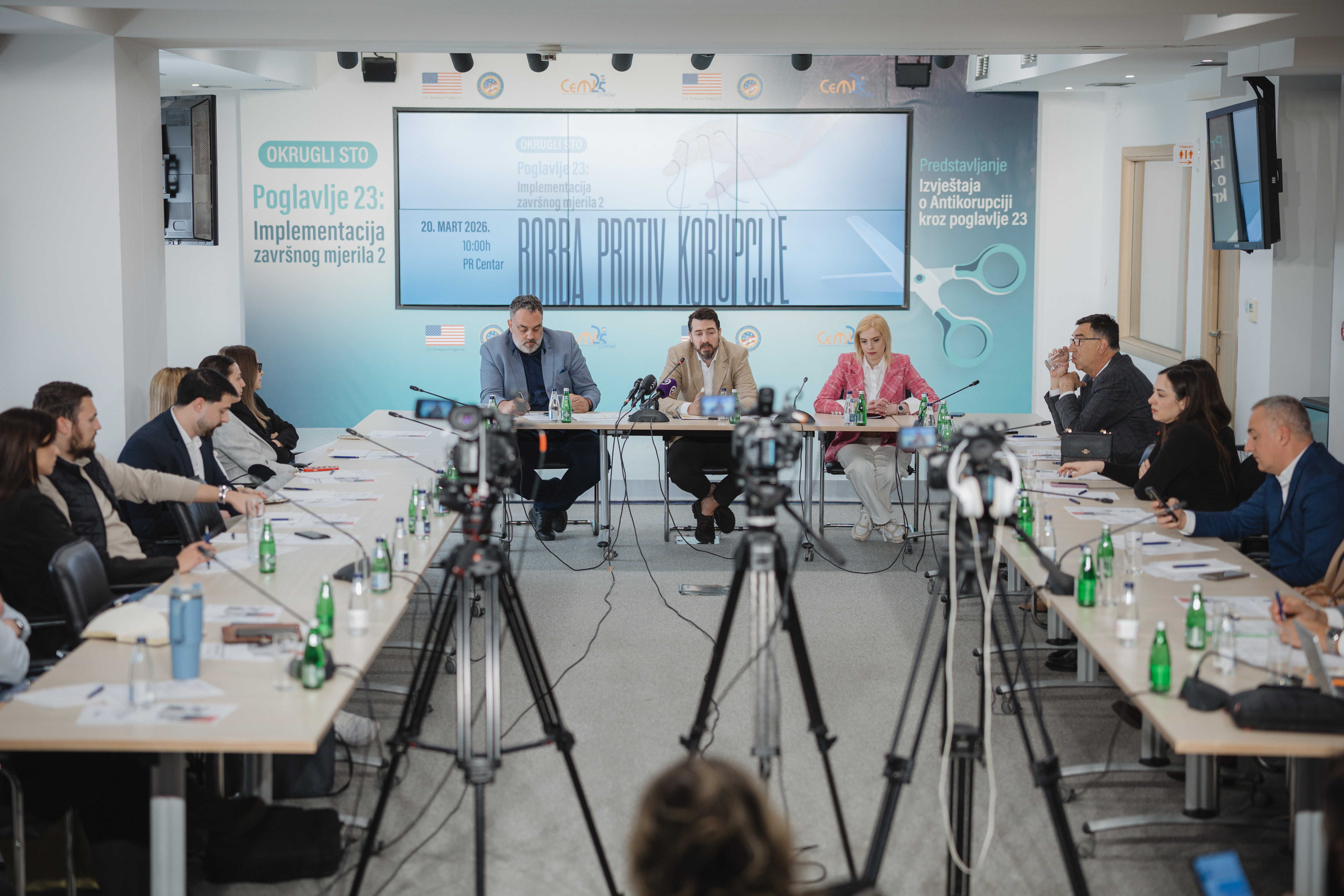
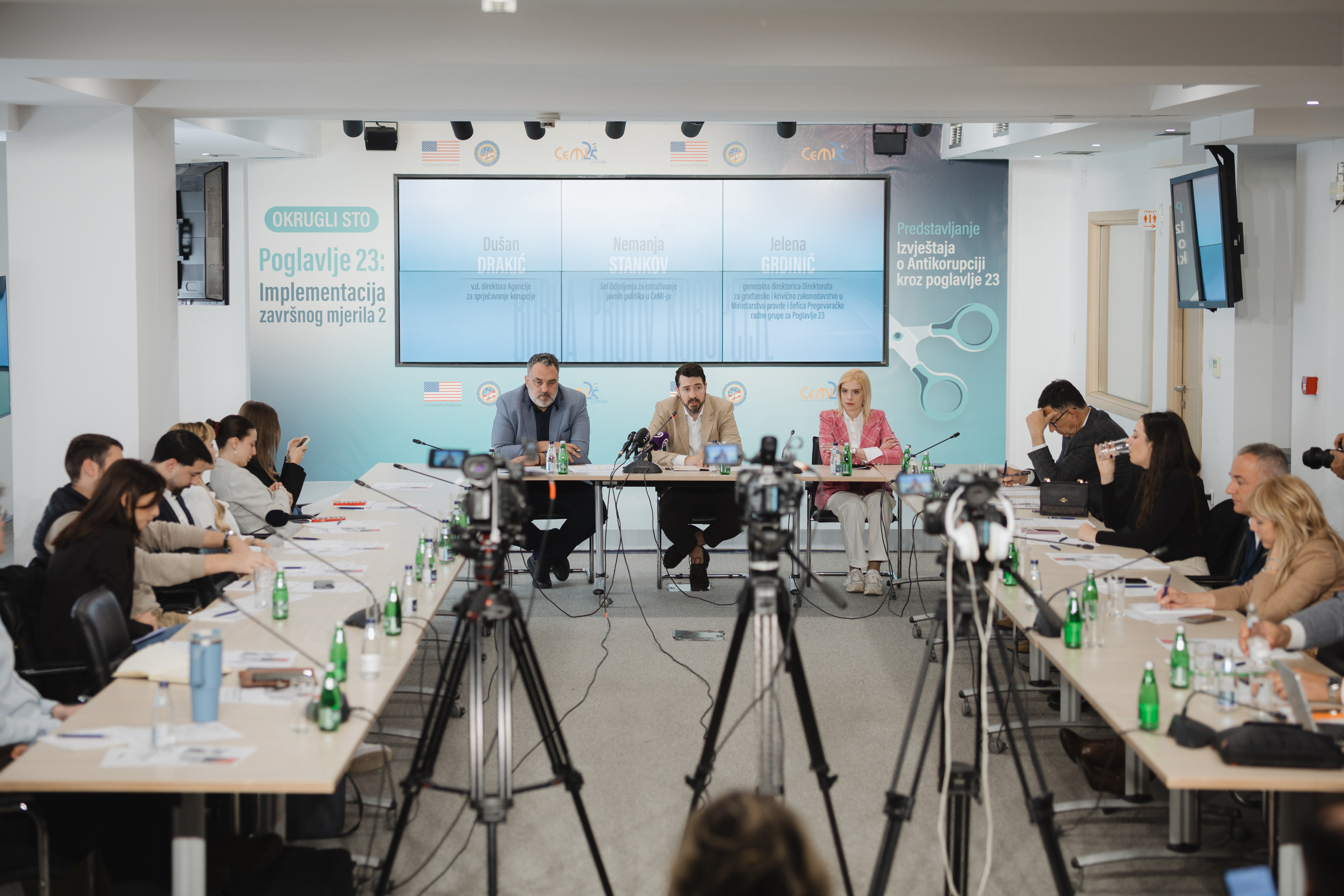
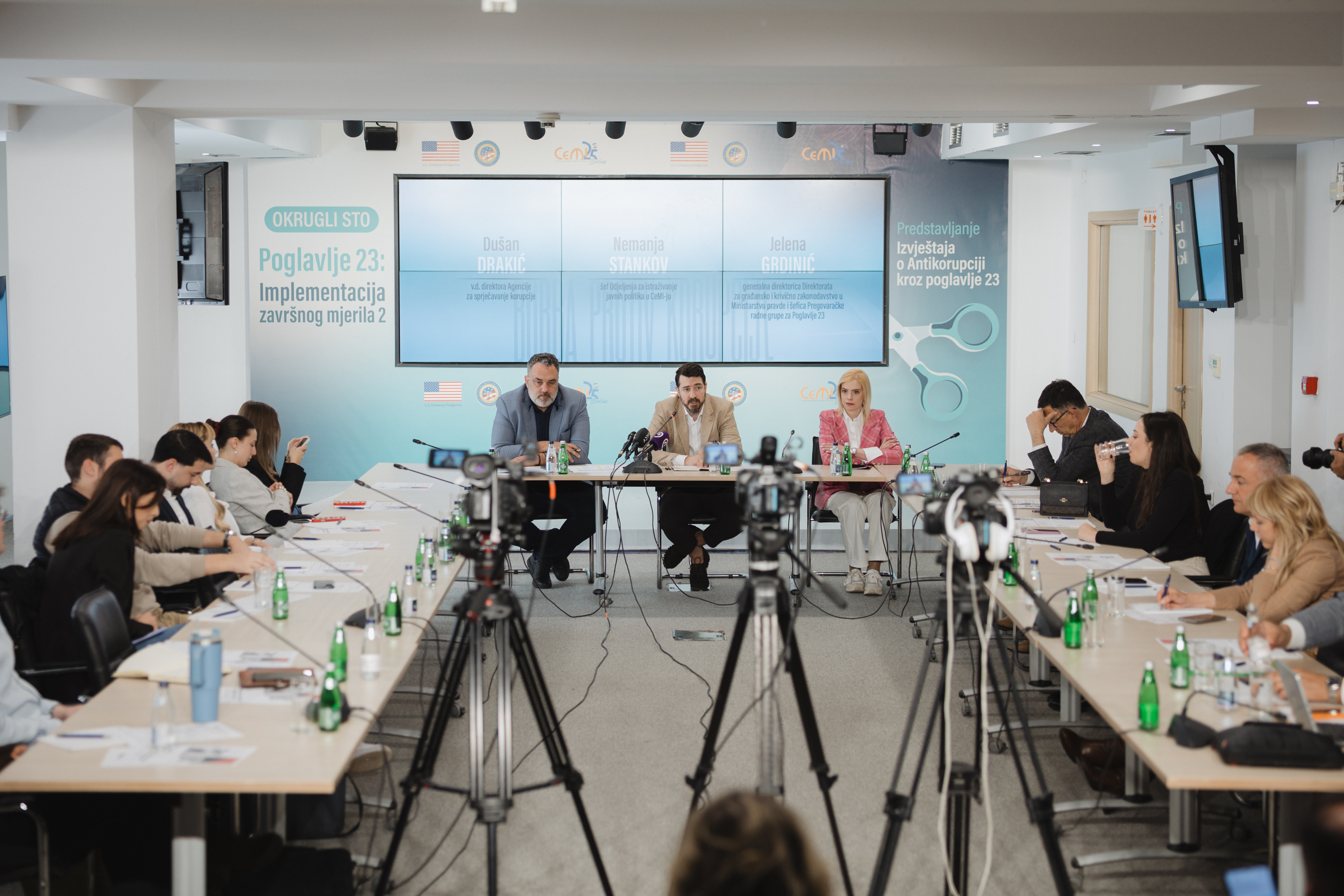
This was announced at the roundtable “Chapter 23: Implementation of Final Benchmark 2 – Fight Against Corruption,” organized today at the PR Center.
Nemanja Stankov, Head of the Public Policy Research Department at CeMI, noted that some technical progress has been made in the past period, but the question of its actual implementation and impact remains open.
He reminded that the negotiation process with the European Union fundamentally relies on progress in Chapters 23 and 24, emphasizing that without measurable results in these areas, full membership cannot be achieved.
Speaking about the first task of Final Benchmark 2, which relates to strengthening the operational capacities of anti-corruption institutions, Stankov pointed out the issue of the Agency for the Prevention of Corruption operating without a director in full mandate for over a year and a half.
“Three public competitions have not resulted in the selection of a director, and a fourth has been announced. The European Commission has clearly stated that the Council must urgently appoint a director, yet the responses so far have remained formal,” Stankov said.
According to him, the lack of stable leadership raises questions about the institution’s independence and the potential for political influence on its work.
Stankov also highlighted that the second key task concerns the assessment of results in the fight against corruption, particularly the work of the Special State Prosecutor’s Office and the courts.
He noted that there has been some progress in the number of investigations, but indictments have not followed the same trend.
“Particularly problematic is that progress is measured quantitatively, without insight into the quality of cases. The number of investigations and indictments tells us nothing about the seriousness of the crimes or their real impact on the system,” Stankov said.
Speaking about court proceedings, Stankov pointed out a slight reduction in their duration, but a significant gap remains between temporary and permanent seizure of assets obtained through criminal activity.
“While millions of euros and substantial property are seized temporarily, permanent confiscation is limited to individual cases, such as a single vehicle,” Stankov explained.
In the area of corruption prevention, he highlighted significant delays in adopting key laws, including the Law on the Prevention of Corruption and the Whistleblower Protection Law.
“Although amendments began as early as 2024, the public still lacks clear information on when these regulations will enter parliamentary procedure. Without a complete legislative framework, all institutional preparations remain limited,” Stankov said.
According to him, although a new strategic framework for combating corruption has been established, its implementation is partial.
“Based on available data, only 50.6% of planned activities have been carried out, while for 12.7% no information was available. This is a concerning figure and shows that the process often reduces to mere formal compliance,” Stankov assessed.
He also addressed the Law on Financing Political Entities and Election Campaigns, which has been adopted but still fails to meet recommendations from international institutions.
“Key problems remain unresolved, which is particularly important in the run-up to an election year,” Stankov concluded.
The Director General of the Directorate for Civil and Criminal Legislation at the Ministry of Justice and Head of the Negotiating Working Group for Chapter 23, Jelena Grdinić, stated that Montenegro plans to close Chapters 23 and 24 by the end of the year, but that this will not be possible without concrete reforms in the field of anti-corruption.
"These are the chapters that are opened first and closed last. We certainly will not close them without reforms concerning both prevention and effective fight against corruption," Grdinić emphasized.
She assessed that the process is demanding, given the large number of activities within final benchmark 2, but that, despite the challenges, the country is on the right track.
Grdinić highlighted that progress is monitored through weekly and biweekly action plans submitted by Montenegro to the European Commission, with clearly defined deadlines.
"On a weekly basis, we update activities to show whether there is progress in fulfilling obligations," Grdinić said, adding that this approach contributes to accelerating the pace of work.
Speaking about amendments to the Law on the Prevention of Corruption, Grdinić reminded that work on this legislation began in 2024, after which the draft was sent to the European Commission for opinion.
"During 2025, we awaited comments, and the final evaluation arrived at the beginning of 2026. After further consultations with European Commission experts, the law was improved. We received feedback that it is a significantly enhanced text and that there are no longer any objections, but we are awaiting the European Commission's final confirmation," Grdinić noted.
She reminded that the deadline for adopting this law is the end of the second quarter, namely June 30, in order to allow, as she explained, space for monitoring initial results of its implementation before the chapters are closed.
"In addition, a new law on whistleblower protection is being prepared, which is expected to improve the position of individuals who report irregularities. The aim is to ensure a stronger and more stable legal framework, including judicial protection," Grdinić emphasized.
She said that the draft law has already been submitted to the European Commission, and that additional consultations are currently pending.
Grdinić highlighted several important novelties introduced by the amendments to the Law on the Prevention of Corruption.
"The Agency for the Prevention of Corruption will be granted access to the bank accounts of public officials, with clearly defined data protection mechanisms; an obligation will be introduced to compare declared and actual income, particularly when the difference exceeds 50,000 euros; sanctions will be tightened, including a ban on holding public office for individuals found to have violated the law; public officials who breach the law will not be entitled to compensation after leaving office," Grdinić stated.
She also pointed out that asset declaration obligations have been expanded to include bank accounts and digital assets, as well as the scope of persons required to submit reports, including members of commissions for public procurement, privatization, and concessions.
Referring to the Law on the Financing of Political Entities and Election Campaigns, Grdinić said that further analysis of its alignment with international recommendations is necessary.
"It is necessary to prepare a compliance table and determine the direction in which the reform should continue," Grdinić said, adding that the process will require cooperation between the Government, Parliament, and competent institutions.
She emphasized that all priority laws, after receiving a positive opinion from the European Commission, will be adopted under an urgent procedure and immediately submitted to Parliament.
"In this way, we aim to accelerate the process and fulfill obligations within the prescribed deadlines," Grdinić concluded.
Acting Director of the Agency for the Prevention of Corruption, Dušan Drakić, stated that the fulfillment of obligations within Chapter 23 is based on three key dimensions: normative, institutional, and operational.
In the normative sense, Drakić noted that significant progress had been achieved in the previous period through amendments to numerous laws, including the Law on the Prevention of Corruption, the Law on the Financing of Political Entities and Election Campaigns, as well as regulations relating to civil servants, the Government, and free access to information.
"A large number of laws have already been amended or are in the final stage of amendments, with the support and comments of the European Commission and following conducted public consultations," Drakić said.
At the institutional level, Drakić emphasized that it is crucial for institutions to have the capacity to implement laws in practice, but also to build public trust.
"The fight against corruption must demonstrate consistency, impartiality, and the willingness of institutions to respond effectively to all cases," Drakić emphasized.
He added that it is necessary for institutions to provide a fast and efficient response to all suspicions of corruption, regardless of the outcome of the proceedings.
He placed special emphasis on the need for stronger operational cooperation between preventive and repressive bodies, including the Special State Prosecutor’s Office, the Police Directorate, and other institutions.
"The European Commission insists on data exchange and the interconnection of institutions in order to jointly address problems," Drakić said.
According to him, certain cooperation mechanisms have already been established and should remain sustainable regardless of changes in the leadership of institutions.
Speaking about the work of the Agency, Drakić emphasized that the preconditions have been created to improve the control of asset declarations of public officials.
He announced that the amendments to the Law on the Prevention of Corruption will allow the expansion of control to include related persons in cases where there is suspicion of irregularities.
He also emphasized the importance of regional cooperation, which will enable the verification of officials’ assets outside the borders of Montenegro.
"This is an important tool for preventing the concealment of assets through transferring them to other persons or abroad," Drakić said.
He warned that Montenegro is facing a demanding electoral cycle, with the possibility of elections being held in all municipalities and at the national level at the same time.
"It will be a major challenge, especially in the area of monitoring campaign financing, the influence of third parties, and potential abuses," Drakić stated.
He stressed that the fight against corruption in this segment is the responsibility of all institutions, not only the Agency for the Prevention of Corruption.
Drakić announced that in the previous period the Agency had resolved a large number of backlog cases, including cases related to former and current public officials and political parties.
He added that the goal is to close old cases and shift the focus to current cases, with greater transparency and availability of information to the public and the media.
"The task of the Agency is not only to make decisions, but also to communicate with the public and explain its actions," Drakić concluded.
The round table was organized within the project "Raise Your Voice: For a Corruption-Free Montenegro", implemented by CeMI with financial support from the Bureau of International Narcotics and Law Enforcement Affairs (INL) of the U.S. Embassy in Montenegro.