The fight against organized crime depends on the strength of institutions, and without their strengthening, there can be no effective results. Therefore, Montenegro must improve its human, technical, and international capacities to respond to increasingly complex security challenges.
This was emphasized at the roundtable “Joint Response to Organized Crime – International Cooperation and Institutional Capacities,” held today by our organization.
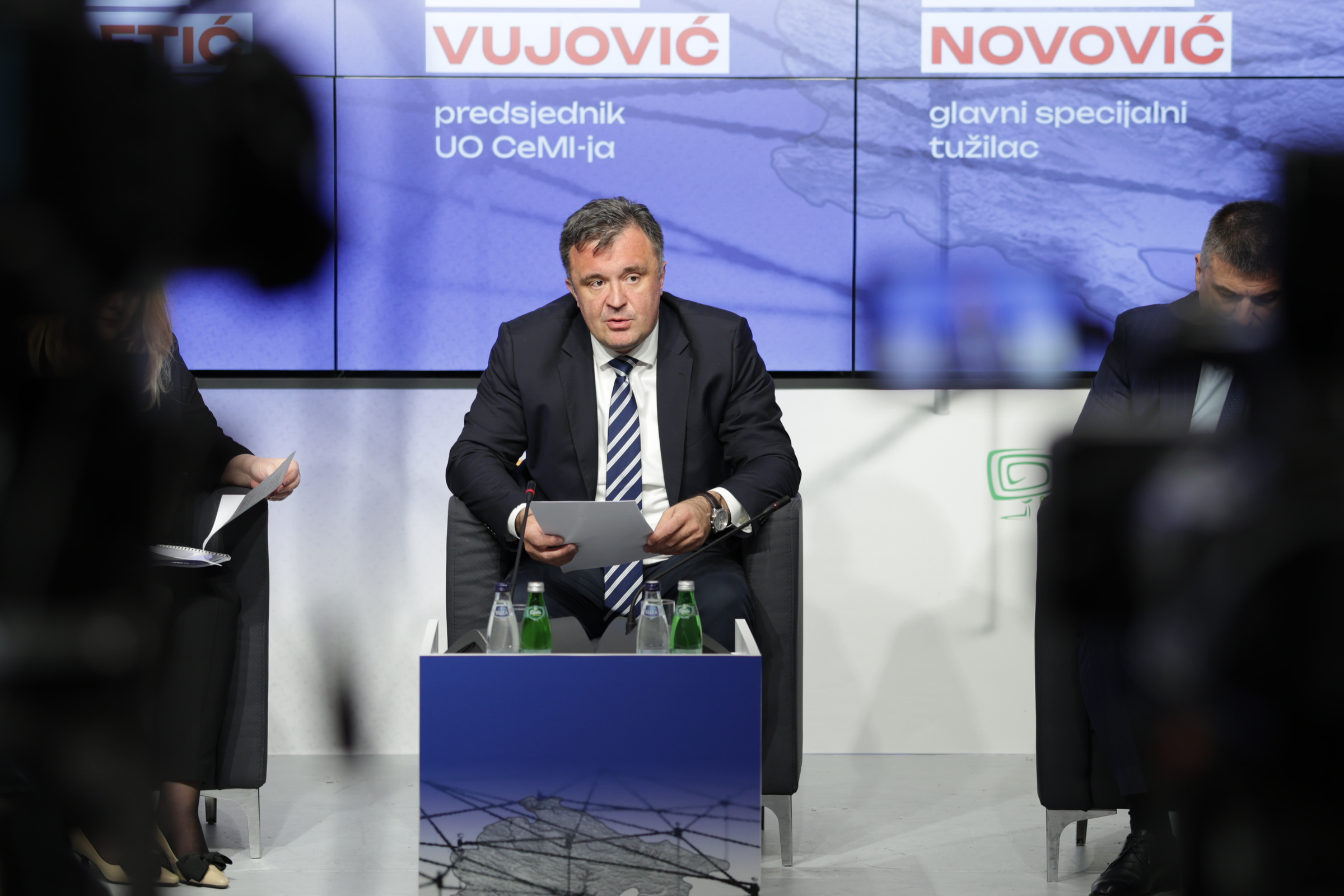
Zlatko Vujović, Chairman of the Board of CeMI, stated that the fight against organized crime is directly conditioned by the strength of institutions, noting that without their reinforcement, effective results cannot be achieved.
He explained that two studies were conducted within the project, addressing key challenges in combating organized crime.
“The first study examines the state of judicial, prosecutorial, and police resources in Montenegro and presents concerning findings. Police capacities in the fight against crime are only about 50 percent filled, meaning the system operates with a serious shortage of personnel. It was also emphasized that institutions operate below European standards in terms of technical and spatial equipment, while coordination between the police, prosecution, and courts is not at the level required by complex cases,” Vujović said.
He stressed that there can be no effective fight against organized crime with a system functioning at half capacity, highlighting the need to strengthen human resources, provide specialized training, and improve infrastructure and professional standards.
“The second study focuses on international cooperation in the fight against organized crime. Although the legal framework is largely aligned with European Union standards, practical results still lag behind, particularly in the areas of financial investigations and asset confiscation,” Vujović noted.
According to him, the study also points to limited capacities for the full implementation of international cooperation mechanisms, emphasizing that passing laws is not sufficient without their consistent and impartial application.
“The recommendations from this study are aimed at strengthening financial investigations and asset confiscation, more active use of international cooperation mechanisms, and further specialization of institutions. Organized crime is as strong as institutions are weak. The key lies in a joint response, both among institutions within the country and in cooperation between states,” Vujović concluded.
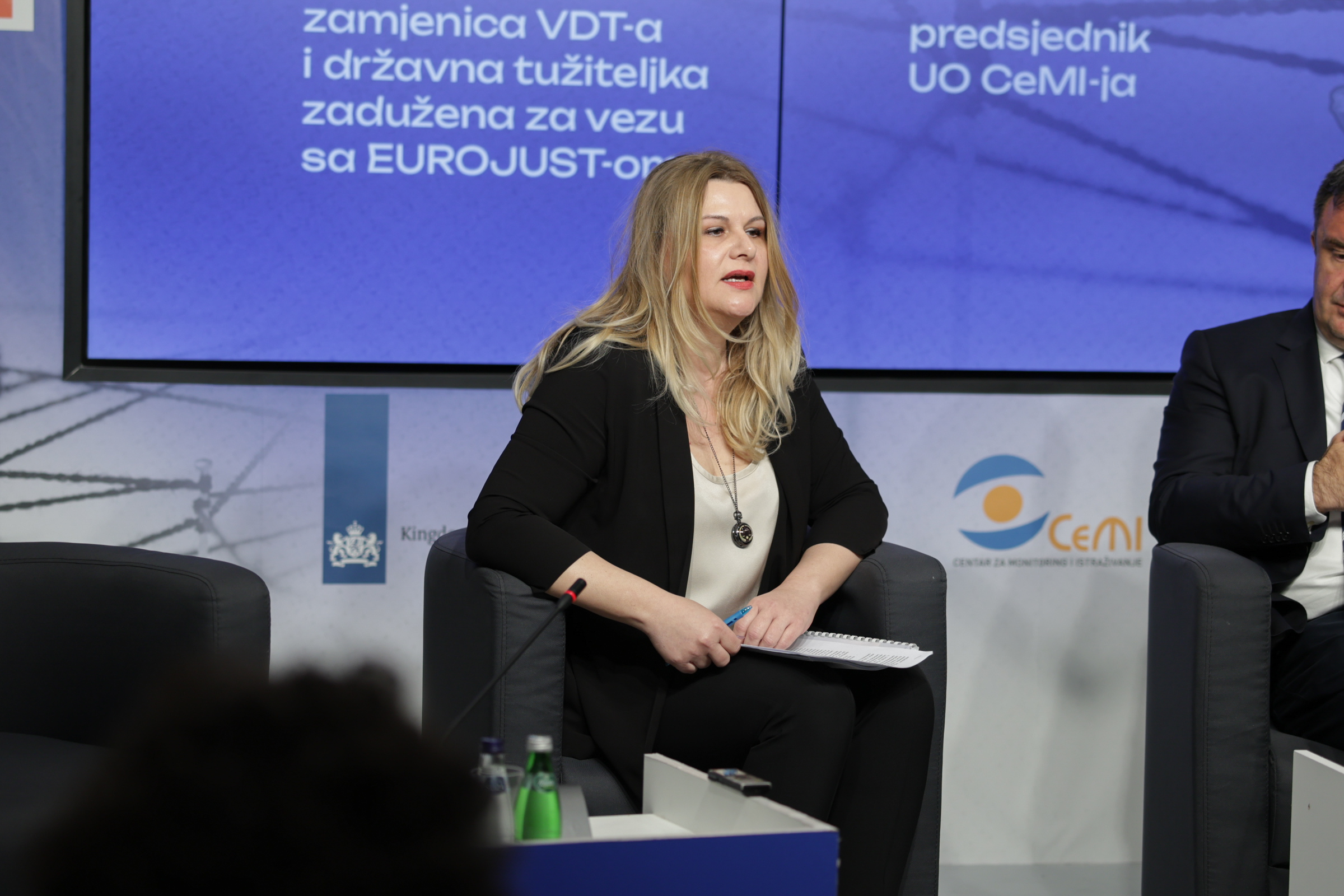
Deputy Chief State Prosecutor and national liaison to EUROJUST, Jelena Đaletić, assessed that international cooperation represents one of the key components in the fight against organized crime, as well as an important indicator of the institutional capacities of the State Prosecutor’s Office.
She recalled that the upgraded Law on International Legal Assistance in Criminal Matters also recognized cooperation with the European Public Prosecutor’s Office (EPPO), enabling Montenegrin judicial authorities both to act on EPPO requests and to submit requests to it.
“The State Prosecutor’s Office has designated a contact point for cooperation with the European Public Prosecutor’s Office, and an agreement has been signed to facilitate concrete collaboration,” Đaletić stated.
She explained that EUROJUST plays a significant role in supporting this cooperation, particularly in cases where states are not fully integrated into EPPO mechanisms, by coordinating activities and leading joint investigations.
According to her, during the past year the Montenegrin prosecution acted on two EPPO requests, one related to the imposition of a temporary asset seizure measure and the other aimed at obtaining evidence and information. In both cases, she highlighted that proceedings were carried out efficiently and within the shortest possible time.
Speaking about cooperation with EUROJUST, Đaletić noted that 80 cases were opened during 2025, emphasizing that this form of collaboration enables direct communication with prosecutorial offices from EU member states as well as third countries.
She particularly highlighted the importance of joint investigation teams, which represent one of the most effective instruments of international legal assistance.
“In the previous period, the Special State Prosecutor’s Office gained experience working in such a team with the Moldovan prosecution, while activities are currently underway to form a joint team with the Albanian prosecution,” Đaletić said.
However, she explained that in practice, parallel investigations often occur between regional states, which, due to good direct communication among prosecutors and the absence of language barriers, are resolved without formally establishing joint investigation teams.
“Through mechanisms such as coordination meetings supported by EUROJUST, effects are often achieved that would otherwise require formal joint investigation teams,” Đaletić noted.
Regarding future obligations, Đaletić emphasized the need for additional training of state prosecutors in the use of European judicial cooperation instruments, especially in the context of Montenegro’s accession to the European Union.
“The Law on Judicial Cooperation in Criminal Matters with EU Member States, currently in preparation, is based on directives that are continuously evolving, making ongoing professional development essential,” Đaletić stated.
Special emphasis was placed on the implementation of the European Arrest Warrant and the European Investigation Order, as well as on improving foreign language skills, particularly English, which is a vital tool for international communication.
Đaletić stressed that the State Prosecutor’s Office is already conducting numerous trainings in this field and that additional educational programs are planned for this year.
She also recalled that over the past year, the prosecution intensified direct cooperation with partner institutions through the signing of memoranda and protocols with regional prosecutorial offices, further strengthening capacities for an effective fight against organized crime.
Chief Special Prosecutor Vladimir Novović emphasized that the stability and security of any society largely depend on a strong institutional response to organized crime, noting that international cooperation in this fight today has strategic importance.
“Organized crime knows no national borders and often exceeds the capacities of individual national systems. Therefore, no single state can independently provide a full response to these challenges,” Novović said.
According to him, combating organized crime requires continuous, robust, and strategically oriented regional and international cooperation, based on rapid information flow, mutual trust, and coordinated institutional action.
Novović highlighted that the Special State Prosecutor’s Office has been developing intensive cooperation with international and regional partners for years, which, he noted, yields concrete and measurable results.
“Thanks to quality data exchange, international legal assistance, and operational coordination, significant results have been achieved in prosecuting complex organized crime cases, especially those involving digital evidence, decrypted communications, and international financial flows,” Novović stated.
He added that these results have been recognized in European Commission reports on Montenegro’s progress, in which the Special Police Department was also evaluated as one of the strongest operational units in the security sector.
However, he warned that the fight against organized crime requires constant adaptation, as modern criminal structures possess significant financial and technical resources, as well as the ability to rapidly adjust to institutional responses.
“For this reason, our response must also be dynamic, deliberate, and long-term oriented,” Novović emphasized.
He stressed the need for further improvement in information exchange and cooperation mechanisms, as well as the continuous strengthening of trust with international partners.
He also pointed out the importance of strengthening internal institutional capacities, noting that without enhancing human, technical, and infrastructural resources, it is not possible to provide an effective response to the complex cases under the jurisdiction of the Special State Prosecutor’s Office.
“Over the past four years, we have worked on capacity building through legislative amendments, organizational improvements, and intensive cooperation with international partners, which has directly impacted our operational results,” Novović said.
He particularly highlighted cooperation with relevant international institutions, including the Federal Bureau of Investigation (FBI), the United Kingdom’s National Crime Agency, the International Narcotics and Law Enforcement Bureau (INL), and Europol, thanks to which technical and informational capacities have been strengthened.
Novović also announced that in the upcoming period, a project is planned to relocate the Special State Prosecutor’s Office and the Special Police Department to a new facility, which would create better working conditions and further capacity building.
“Only through coordinated and professional action can we stay one step ahead of organized crime,” Novović concluded.
The roundtable was organized within the framework of the “Open Trials Project: Monitoring Trials for Organized Crime and High-Level Corruption in Montenegro,” implemented by the Center for Monitoring and Research (CeMI) in cooperation with the Media Union of Montenegro, and funded by the Embassy of the Kingdom of the Netherlands.