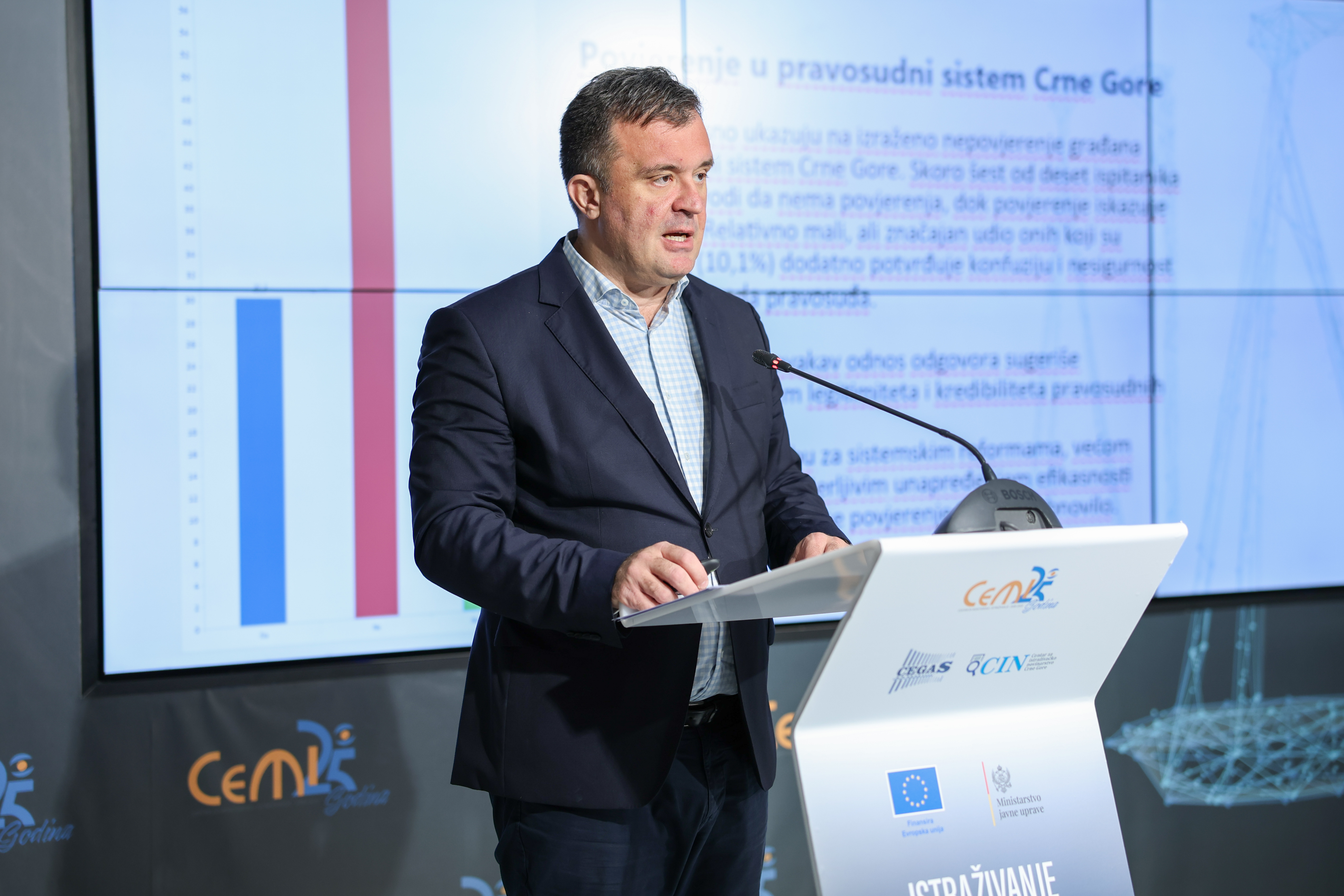
In Montenegro, nearly 60 percent of citizens do not trust the judiciary; they do not perceive the system as a neutral institution above political divisions, and without visible, measurable, and value-based changes, this trust will not be restored.
This was announced on the occasion of presenting a public opinion survey on citizens’ trust in Montenegro’s judicial system, conducted on a representative sample of 995 respondents.
Zlatko Vujović, Chair of CeMI’s Board of Directors, stated that the survey results regarding overall trust in the judiciary are clear and concerning.
“Almost six out of ten citizens, precisely 59.6 percent, report that they do not trust the judiciary. Only 30.3 percent express trust, while around ten percent are undecided. This ratio reflects not only current dissatisfaction but also indicates a deep-rooted problem with the legitimacy and credibility of judicial institutions,” Vujović said.
Speaking about trust trends over more than a decade, Vujović pointed out that distrust in the judiciary is not a temporary phenomenon, but a long-term process.
“The period from 2013 to 2016 represents an exception, when trust increased and reached its peak of 53 percent,” Vujović noted.
According to him, from 2017 onwards, there has been a clear and lasting reversal of the trend.
“Trust in the judiciary began to decline continuously, with short and limited fluctuations that were insufficient to change the overall direction. A particularly sharp drop occurred after 2020, when trust fell to 34 percent, and then, despite a slight recovery in 2023, reached a historic low of 30 percent in 2025. At the same time, distrust has increased, reaching 60 percent in 2025, which means that distrust has become the dominant and stable position of the majority of citizens,” Vujović said.
He emphasized that this longitudinal pattern indicates that the trust crisis cannot be explained by individual scandals or political cycles.
“On the contrary, this is the accumulated effect of a long-standing perception of politicization, selective justice, slow procedures, and the absence of visible results from reforms. Once lost, trust is not automatically restored by a change of government or personnel changes in institutions, but requires a long-term and consistent institutional impact,” Vujović said.
He noted that a similar, and in some segments even more pronounced, negative pattern is observed when it comes to the prosecution.
“Over time, trust in the prosecution shows limited and short-term improvements, but without a stable upward trend. Citizens increasingly perceive the prosecution as a key link in the rule-of-law system that fails to meet expectations in the fight against high-level corruption and organized crime,” Vujović said.
He pointed out that trust in the Supreme State Prosecutor’s Office, observed longitudinally, remains low and is strongly conditioned by the political context.
“Periods of slight increases in trust are generally linked to announced reforms or changes in leadership positions, but these effects are short-lived. Shortly thereafter, trust returns to the previously low level, indicating that symbolic or personnel changes are insufficient without visible and measurable results in practice,” Vujović noted.
Speaking about the Special State Prosecutor’s Office (SDT), Vujović said that longitudinal data indicate even greater volatility in trust.
“The SDT is an institution from which the public has high expectations, but these expectations are often accompanied by deep disappointment. Trust in the SDT shows sudden fluctuations — it rises at moments when proceedings are announced or initiated in high-level corruption cases, and then sharply declines when final verdicts are not delivered or when these proceedings are perceived as selective or politically motivated,” Vujović stated.
He believes that this very instability of trust in the SDT carries particular significance.
“It shows that citizens closely monitor the work of the prosecution and do not grant trust in advance, but condition it on concrete outcomes. In a longitudinal sense, the trend for 2025 indicates that the credit of trust toward the SDT is largely exhausted, and citizens’ expectations have become significantly more cautious and skeptical than before,” Vujović said.
According to him, a longitudinal overview of trust in the judiciary and prosecution, both overall and with respect to key institutions such as the Supreme State Prosecutor’s Office (VDT) and the SDT, clearly demonstrates a pattern of structural distrust.
“Citizens do not perceive these institutions as stable, predictable, and independent actors in the rule of law, but rather as systems whose performance depends on the political and social context. This is particularly concerning because the judiciary and prosecution are precisely the institutions that should represent points of institutional continuity and legal certainty,” Vujović said.
He explained that an analysis of trust by the political parties respondents would vote for reveals an additional dimension of the problem, noting that the judiciary is not perceived as a neutral institution above political divisions.
“Trust or distrust often follows political lines, which further undermines the idea of the judiciary as an independent and impartial pillar of the system,” Vujović said.
He pointed out that in response to the question of whether the average citizen can expect a fair and just trial, a relative majority of 44 percent stated that the judiciary can mostly ensure a fair trial.
“However, nearly 40 percent believe it cannot, while only seven percent are firmly convinced that the judiciary reliably ensures justice. These data reflect a reserved, fragile trust. Citizens are not fully confident in the system, but they still leave room for the possibility of being treated fairly in a specific case,” Vujović said.
According to him, the trends reveal an interesting paradox.
“While overall trust in the judiciary is declining, personal expectations of fair treatment in specific proceedings remain relatively stable, and are even higher than before. In 2023, as many as 57 percent of citizens believed they could expect a fair trial, while in 2025 this percentage slightly decreased to 51 percent. At the same time, the share of those who believe fair treatment is not possible is growing. The undecided group is disappearing, and opinions are crystallizing. This is a typical pattern in transitional systems: citizens tend to trust individuals more than institutions as a whole,” Vujović explained.
He pointed out that one of the most consistent negative findings concerns the duration of court proceedings.
“Even 72 percent of citizens believe that judicial processes take too long. Only 13 percent believe they take as long as necessary. There is almost no doubt here — the perception of inefficiency is widespread and stable. Trends further confirm that this problem is worsening. After a short-term decline in negative perceptions in 2020, in 2025 we reach the highest level of dissatisfaction — 72 percent of citizens consider the courts insufficiently efficient,” Vujović said.
He emphasized that the majority of citizens have no direct experience with the judiciary.
“Only around 27 percent had any contact with judicial institutions in the past two years. The most common contacts were with the police and lawyers, while contact with courts and the prosecution is limited, and with the Ombudsman almost negligible. This means that citizens’ views on the judiciary are largely formed through indirect sources — media, political discourse, and public narratives,” Vujović said.
He added that among those who have had personal experience with courts, there is no clearly dominant satisfaction.
“On the contrary, there is a combination of ambivalent and negative assessments. This means that even direct contact often does not produce a strong positive effect on trust,” Vujović added.
He pointed out that an analysis of trust in specific institutions — courts, prosecutions, and councils — shows a pronounced legitimacy crisis.
“For almost all institutions, negative trust is greater than or equal to positive trust. Even where trust is relatively higher, it does not reach a level indicating broad societal support,” Vujović said.
He emphasized that statistical analyses show that contact with institutions can increase trust, but that effect is limited.
“It is particularly interesting that contact with the Ombudsman has the strongest positive effect, yet the number of citizens who have such contact is extremely small. This confirms that the problem is not only the lack of contact, but also the quality of institutional performance,” Vujović noted.
He stated that citizens perceive corruption and political influence as the dominant problems in the functioning of the courts.
“This is extremely important: citizens do not see inefficiency as an isolated technical issue, but as a consequence of compromised system integrity. Only 11 percent of citizens believe that courts operate without any external influence. The majority perceive strong political and informal pressure, while institutional actors are seen as significantly less influential,” Vujović said.
He noted that over 60 percent of citizens believe that judges are neither selected nor promoted based on merit.
“The key factors cited are political connections and ties to centers of power within the judiciary. This directly undermines trust in the professional integrity of the system,” Vujović added.
He said that a similar picture emerges regarding the prosecution, with almost 59 percent of citizens believing that the prosecution is not independent.
“The main sources of influence cited are the government, political parties, and influential individuals. Corruption and political pressure once again dominate as the main problems,” Vujović noted.
He added that citizens were also asked about reform priorities, indicating that the most frequently mentioned priorities are greater justice and fairness, hiring qualified personnel, and reducing corruption, while speeding up proceedings comes only after these issues.
“This clearly shows that citizens perceive reform primarily as a matter of values and integrity, and only then as a technical issue,” Vujović stated.
He noted that television and online media are the dominant sources of information about the judiciary.
“However, trust in media reporting is limited and ambivalent. Neutral and negative attitudes prevail, which further complicates the relationship between the judiciary, media, and the public,” Vujović said.
He believes the findings of this research indicate a deep and long-lasting crisis of trust in Montenegro’s judicial system.
“Citizens clearly recognize problems of integrity, independence, and fairness. The message from the public is clear: without visible, measurable, and value-based changes, trust will not be restored,” Vujović emphasized.
He added that, from the citizens’ perspective, judicial reform must bring a sense of justice, fairness, and equality before the law.
“Everything else — efficiency, procedures, organization — only makes sense if it serves these fundamental values,” Vujović concluded.
The full report on the survey can be found in our publications and via the following link: 48mY3zpxYdrmHbNyqw7tD1ATGj3z2fT4DgQwqfDJ.pdf
The public opinion survey on citizens’ trust in the judiciary was conducted as part of the project “Support for Montenegro’s EU Integration – for an Independent and Professional Judiciary as a Key Prerequisite!”, funded by the European Union and co-financed by the Ministry of Public Administration of Montenegro, and implemented in partnership with CIN-CG and CEGAS.